
For many established HoReCa chains, gluten-free menu options are still treated as a “nice to have” rather than a revenue opportunity. The common response is familiar: the demand is too small, the menu is already crowded, and the operational risk may not be worth it. Yet this hesitation often causes chains to overlook a valuable customer segment that is actively searching for safer, more inclusive dining choices. See what market data is saying.
The better question is not whether gluten-free demand exists. It does. The better question is how chains can introduce it without damaging consistency, profitability, or kitchen efficiency. That is where gluten-free menu pilots become a practical bridge from uncertainty to measurable business results.
Why Established Chains Say No First
Most chains resist gluten-free offerings for reasons that sound logical on the surface. They worry about separate storage, staff training, contamination risk, product wastage, and whether the item will move fast enough to justify the operational complexity. In large-format businesses, even a small operational change can feel like a big internal conversation.
There is also a deeper issue: chains are often built around scale and standardization. Anything that looks “special handling” can appear expensive, risky, or difficult to replicate across outlets. So the default answer becomes delay, and delay quietly becomes lost revenue.
The Demand Is Smaller Than Mainstream — But Not Small
Gluten-free guests are not the entire market, and they do not need to be. In fact, a specialty segment can still deliver meaningful revenue when it is high-value, loyal, and under-served. These customers include celiac patients, gluten-sensitive diners, diabetics, fitness-oriented consumers, and health-conscious families who are willing to pay more for trust and convenience.
For chains, the upside of gluten-free menu pilots is not just direct sales. It is also repeat visits, word-of-mouth, better reviews, and stronger brand perception. A guest who finally finds a place that says “yes” to gluten-free is often a guest who returns.
The Real Risk Is Not Trying
Many operators assume the biggest risk lies in introducing a gluten-free item. In reality, the bigger risk may be ignoring a profitable niche while competitors quietly test it. A chain that remains absent from this space can lose health-aware customers to smaller, more agile competitors.
This is especially important in urban markets where premium guests expect more than just taste. They expect choice, transparency, and care. A chain that introduces gluten-free menu pilots in a smart way can position itself as modern and customer-centric without overhauling its entire operation.
How Pilots De-Risk the Decision
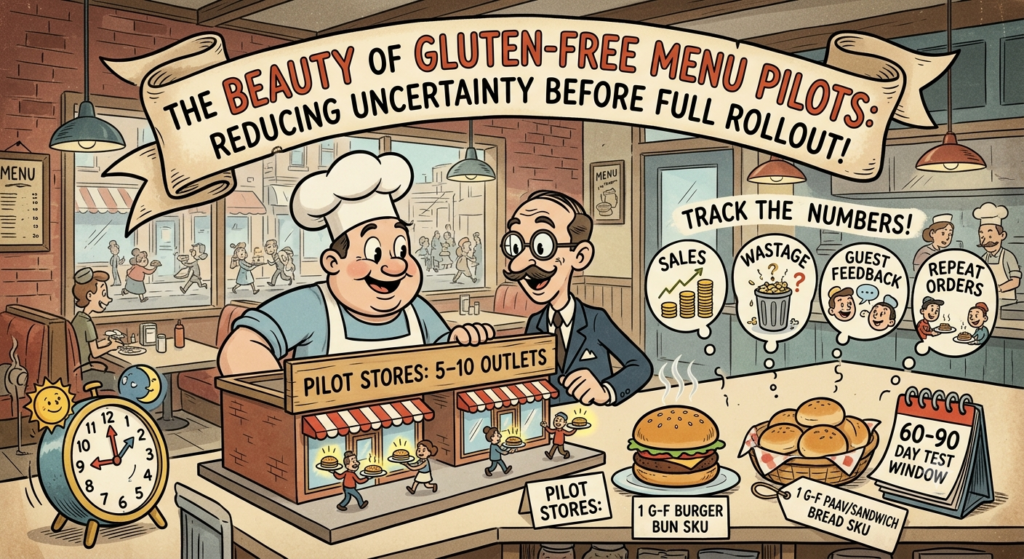
The beauty of gluten-free menu pilots is that they reduce uncertainty before a full rollout. Instead of launching across all outlets, a chain can test one or two SKUs in a selected set of stores and track the numbers. A practical pilot could include:
- One gluten-free burger bun SKU.
- One gluten-free paav or sandwich bread SKU.
- 5–10 selected outlets.
- A 60–90 day test window.
- Clear metrics for sales, wastage, guest feedback, and repeat orders.
This approach gives leadership real data instead of assumptions. It also gives chefs and outlet managers time to learn the product, simplify handling, and understand customer response.
Revenue, Profitability, and Brand Value
When done well, gluten-free menu pilots can support both top-line and bottom-line growth. Specialty items often carry better pricing power because guests see them as value-added and safety-oriented. For example, a gluten-free burger or sandwich can be positioned as a premium menu item rather than a commodity add-on.
The brand benefit matters too. Guests increasingly reward outlets that show awareness of dietary needs. That means stronger trust, more shareable dining experiences, and improved brand goodwill. In competitive markets, that can be as valuable as the direct sale itself.
What Chains Need to Get Right
To make gluten-free menu pilots work, chains need four things:
- A reliable sourcing partner who understands product quality and consistency.
- Clear operational SOPs for storage, prep, and service.
- Simple communication on the menu and at the counter.
- A pilot mindset that focuses on learning, not perfection.
The point is not to create a complicated “special diet” system. The point is to offer a small, commercially sensible gluten-free solution that fits into existing operations.
A Smarter Way Forward
Established chains do not need to become health-food brands overnight. They simply need to stop treating gluten-free as a distraction. A controlled pilot can prove demand, build confidence, and reveal a new revenue stream with limited risk. That is why gluten-free menu pilots are one of the smartest ways for HoReCa chains to move from hesitation to results. When the data is visible, the decision becomes easier.
If you are a QSR, café chain, hotel group, or restaurant brand exploring gluten-free menu pilots, I can help connect you with the right manufacturers and product options for safe, practical implementation. Click here for support.
For pilot discussions, sourcing enquiries, or gluten-free product requirements, please reach out. Let us design a low-risk entry into a high-potential market segment.