
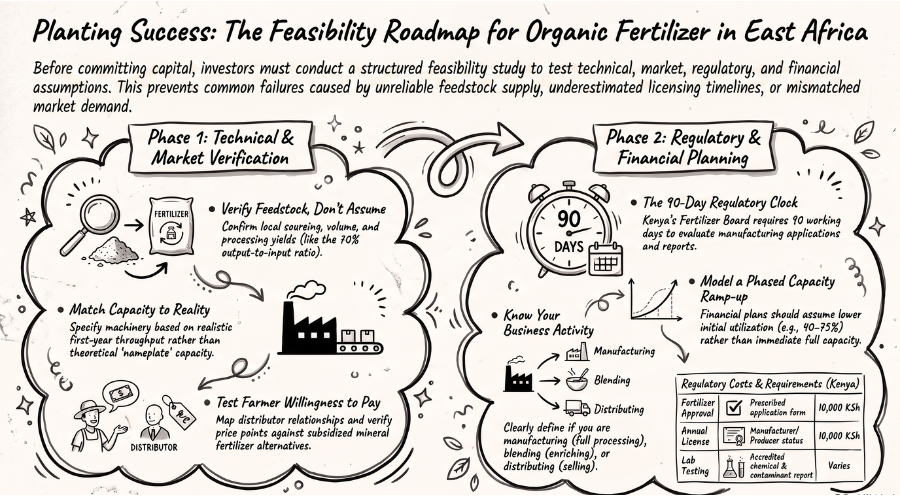
Before committing capital to a manufacturing facility, every serious investor needs a structured feasibility study for an organic fertilizer plant in East Africa — one that tests technical, market, regulatory and financial assumptions before, not after, equipment is purchased.
Why feasibility work comes before machinery selection
A feasibility study is a systematic assessment covering management, marketing, technical, financial and regulatory dimensions of a proposed venture — not simply a cost estimate for equipment. Skipping this step is the most common reason organic fertilizer projects underperform: raw-material assumptions prove unreliable, registration timelines are underestimated, or projected demand does not match actual farmer purchasing behavior.
Core components of the feasibility study
1. Feedstock and technical assessment
Start by verifying, not assuming, your raw material supply. Reference feasibility models for organic fertilizer plants define specific technical parameters that should be tested locally:
- Confirmed sourcing and volume of feedstock (e.g., rice straw, cow dung, agro-processing residues, market waste) at affordable and consistent prices
- Expected processing yield — one Indonesian slaughterhouse-waste feasibility study modeled the composting yield, while another rice-straw/cow-dung model assumed roughly 70% output-to-input ratio. Read the source…
- Plant capacity, land area requirement, and machinery specification matched to realistic first-year throughput rather than nameplate capacity
- Water, power, and logistics access at the proposed site
2. Market and commercial study
The study must establish genuine demand, not aggregate market-size figures. This includes identifying target crops and farmer segments, verifying willingness to pay versus subsidized mineral-fertilizer alternatives, mapping distributor and agro-dealer relationships, and testing pricing against both imported products and other local producers.
3. Regulatory and licensing pathway
In Kenya, any person intending to establish a fertilizer manufacturing or production plant must apply to the Fertilizer and Animal Foodstuffs Board using a prescribed form, and must demonstrate a Kenya-registered company with a disclosed ownership structure and a written feasibility plan. The Board is required to complete its evaluation and issue a written report within 90 working days of application submission, in consultation with the relevant county government. Read the source…
Applicants must also submit details on raw materials, including source, an accredited laboratory’s chemical composition test results, and a declaration that the material is free from — or contains only tolerable levels of — restricted or deleterious substances under Kenya Standards. Separate license fees apply: KSh 10,000 for fertilizer approval, KSh 10,000 annually as a manufacturer/producer, and KSh 5,000 annually as a distributor, per Kenya’s Ministry of Agriculture regulatory impact statement.
| Registration step | Requirement |
|---|---|
| Company registration | Kenyan-registered company with registered office and disclosed shareholding |
| Feasibility plan | Written feasibility plan submitted with application |
| Raw material documentation | Source, accredited lab composition test, and contaminant declaration |
| Board evaluation | Written report within 90 working days, in consultation with county government |
| Zoning and safety compliance | Occupational safety, environmental and industrial zoning compliance required |
| Appeal process | Refused applicants may appeal to the Cabinet Secretary within 30 days |
Note: fertilizer manufacturing regulation is distinct from any general investment or tax-incentive registration (e.g., KenInvest or SEZ applications) — both processes typically run in parallel, not as substitutes for one another.
4. Financial and capital planning
Financial feasibility must estimate capital expenditure (land, buildings, machinery, working capital) and operating expenditure (raw materials, labor, utilities), then test these against realistic capacity-utilization assumptions. Reference project models illustrate the type of phased ramp-up investors should plan for — one Indian pre-feasibility report for an organic fertilizer unit assumed 75% capacity utilization in year one, rising 5% annually toward 95%, while another project model assumed a lower 40% first-year machine-utilization rate, increasing to 90% by year six. These figures are illustrative of realistic ramp-up patterns only and should not be treated as applicable benchmarks for an East African facility, where local capacity utilization must be independently modeled.
5. Social and environmental review
A complete study should also assess environmental compliance (waste handling, emissions, water use) and the project’s contribution to local objectives such as reduced synthetic-input dependence, soil health improvement, and rural employment.
Manufacturing, blending, and distribution require separate assessment
A feasibility study should clearly define which activity the venture will undertake, since each carries different capital and regulatory implications:
- Manufacturing — full processing from raw feedstock, requiring the plant registration pathway above
- Blending/formulation — combining or enriching already-processed inputs, which may carry separate classification requirements
- Distribution — selling finished product, requiring a distributor license rather than a manufacturing certificate.
Where technical collaboration adds value
Indian MSMEs with organic fertilizer and biofertilizer manufacturing experience can support the technical feasibility components — process design, machinery specification, capacity planning, and quality-control protocol development — while the East African partner leads feedstock sourcing, land acquisition, local registration coordination, and market access. Structuring this division clearly within the feasibility study itself helps both parties understand respective responsibilities before financial commitments are made.
Regulatory and feasibility caution
This article outlines general components of a feasibility study and cites Kenya-specific regulatory steps as an illustrative example; requirements differ across Uganda, Tanzania, Rwanda and other East African markets, and regulations are subject to revision. Capacity-utilization, yield, and cost figures cited from published feasibility models are illustrative only and are not projections for any specific project. This article does not constitute financial, legal, or regulatory advice — investors should commission an independent, site-specific feasibility study and confirm current registration requirements with the relevant national fertilizer regulatory authority before committing capital.
Planning an organic fertilizer or biofertilizer manufacturing project in Kenya, Tanzania, Uganda, or elsewhere in East Africa?
Gondwana Treasures helps identify suitable Indian MSME technical partners to support feasibility planning, formulation design, machinery guidance, and commissioning coordination for your proposed plant. Contact Gondwana Treasures to discuss your project location, feedstock sources, and feasibility-study requirements.