
Kenyan fertilizer distributors have long operated on thin margins within an import-dependent supply chain. As currency pressure, freight costs, and subsidy-driven price competition compress those margins further, a growing number are evaluating the shift from importing to joint-venture manufacturing as a more durable business model.
Why import margins are structurally thin
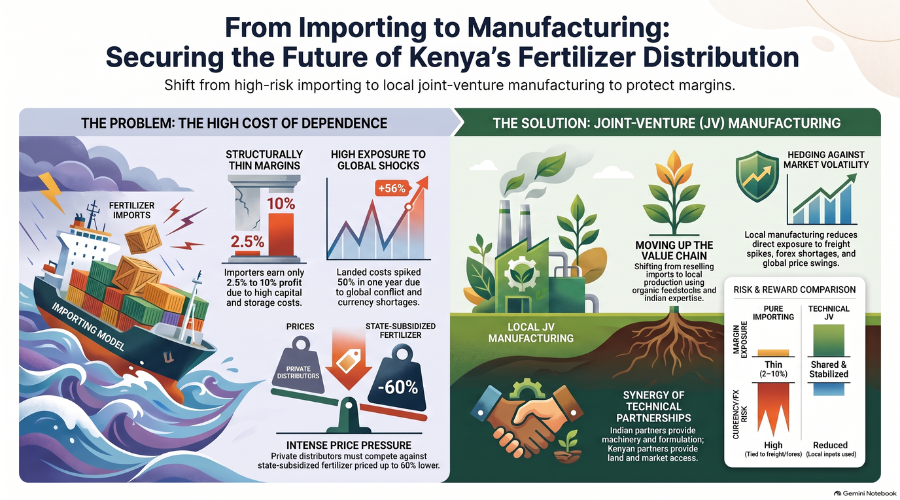
Independent market analysis shows Kenyan fertilizer distributors and agro-dealers earn very low margins on imported product. The Competition Authority of Kenya’s market inquiry found agro-dealer mark-ups of roughly KSh 200 per 50kg bag or less, while importer profit margins ranged from about 2.5% to 10%, with the Fertilizer Association of Kenya citing an industry-general margin of approximately 5%. An earlier IFDC assessment similarly found agro-dealer gross margins of only 2–4% of cost, given the high capital tied up in purchasing and storing bulky fertilizer stock. Read the source…
These thin margins exist because Kenya imports approximately 95% of all fertilizer, with clearance fees, transport costs and mark-ups together representing roughly 30% of the consumer price, according to a TechnoServe study for the UK’s FCDO (2023). A detailed cost build-up for bulk DAP from Morocco in 2022 showed FOB price, freight, port charges and bagging consuming the bulk of landed cost, leaving distributor and agro-dealer margins below 3%. Read the source…
Currency and global-price shocks compound the problem
Distributors face exposure beyond thin margins alone. The average landed cost of fertilizer in Kenya rose 56% in a single year — from KSh 32,789 to KSh 51,168 per metric tonne — following the Russia-Ukraine conflict’s disruption of global fertilizer supply, according to Kenya National Bureau of Statistics data reported by Business Daily Africa (2022). Separately, a weakening shilling and dollar shortages have squeezed importers’ ability to secure foreign currency for raw material and input purchases, according to Nation Media Group reporting (2023).
FOB fertilizer prices increased by 100% following the outbreak of the war in Ukraine, directly limiting supply and raising costs across the import chain, per the TechnoServe/FCDO analysis.
Government subsidy programs add further margin pressure
Kenya’s fertilizer subsidy program has substantially lowered farmer-facing prices — a 50kg bag now costs farmers KSh 2,500 through the e-voucher system, down from KSh 6,500–7,500 in open-market channels. While beneficial for farmers and national maize production (reported to have risen from 61.7 million to 85.7 million 50kg bags between 2022 and 2025), subsidised government distribution through NCPB and KNTC depots represents a parallel channel that private distributors and agro-dealers must compete against, generally without matching state-backed pricing power.
Manufacturing, blending, and distribution: different risk profiles
| Business model | Margin exposure | Currency/FX risk | Capital requirement |
|---|---|---|---|
| Pure importing/distribution | Thin (2–10%), per CAK/FAK data | High — landed cost tied to FOB, freight, forex | Moderate; working capital for inventory |
| Local manufacturing (organic/bio-fertilizer) | Potentially wider if feedstock is local and quality-differentiated | Lower — reduced dependence on imported finished product | Higher upfront capex for plant and equipment |
| Blending/formulation | Depends on imported vs. local raw material mix | Partial — some imported inputs may remain | Moderate; requires formulation know-how |
| Technical collaboration (JV) | Shared between technical and capital partners | Reduced for the local partner if inputs are sourced domestically | Shared between Indian technical partner and Kenyan investor |
Why joint-venture manufacturing is gaining attention
A joint venture structure allows a Kenyan distributor or investor to move up the value chain — from reselling imported product at thin, currency-exposed margins, toward manufacturing organic fertilizer, biofertilizer or bio-enriched manure using locally available feedstocks and Indian technical expertise. This does not eliminate market risk, but it can reduce direct exposure to FOB price swings, freight cost spikes and forex shortages that specifically affect imported finished fertilizer.
Indian MSMEs manufacturing organic fertilizers and biofertilizers can contribute:
- Product formulation and quality-control systems
- Machinery selection and commissioning support
- Staff training and capacity building
- Technical guidance for scaling production to match local demand
The Kenyan distributor or investor, in turn, typically contributes:
- Capital and land for the manufacturing facility
- Existing distribution relationships and market access
- Local registration and regulatory compliance coordination
- Operational management
What distributors should evaluate before shifting models
Moving from import-distribution to manufacturing is a significant strategic change, not a simple upgrade. Distributors considering this shift should assess:
- Feedstock availability: whether reliable local organic or bio-input raw materials exist near the proposed plant location
- Registration requirements: fertilizer manufacturing registration is a separate regulatory process from distribution licensing
- Capital intensity: manufacturing requires materially higher upfront investment than distribution alone
- Market positioning: whether local organic/bio-fertilizer products can be priced competitively against subsidised mineral fertilizer channels
- Technical partnership terms: clarity on the respective roles, IP, and responsibilities of technical and capital partners in a joint venture
Feasibility and regulatory caution
This article presents general market context and does not constitute financial, investment or regulatory advice. Fertilizer manufacturing registration requirements, margin structures, and subsidy program terms are subject to change. Prospective investors should verify current registration requirements with Kenya’s fertilizer regulatory authorities and commission an independent feasibility study, including realistic feedstock, cost and market assessments, before committing capital to a manufacturing joint venture.
Is your distribution business exploring a shift from importing toward local manufacturing to protect margins against currency and freight volatility?
Gondwana Treasures helps Kenyan and East African agri-distributors identify suitable Indian MSME technical partners for organic fertilizer and biofertilizer joint ventures — supporting formulation guidance, plant setup coordination, and initial B2B introductions. Contact Gondwana Treasures to discuss your distribution business, target product category, and joint-venture interest.