
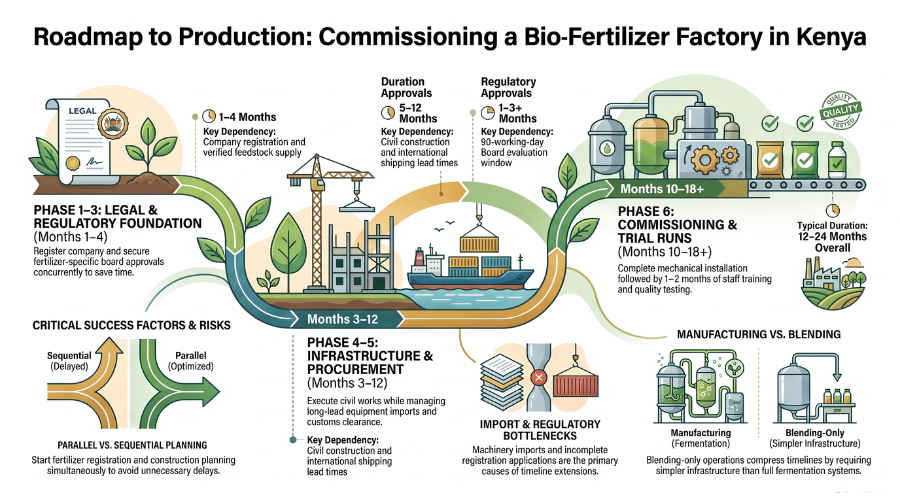
Investors evaluating a Kenyan bio-fertilizer venture need a realistic bio-fertilizer factory commissioning timeline, not an optimistic best-case estimate. Based on general industry benchmarks for organic fertilizer production lines and Kenya-specific registration data, a phased setup typically spans 12–24 months from planning to commercial output — longer than many first-time investors expect.
Phase 1: Company registration and legal setup (2–4 weeks)
Kenya’s company incorporation process is comparatively fast. A private limited company with complete documentation can be registered through the eCitizen Business Registration Service (BRS) typically within 3–7 working days. However, full operational readiness — including KRA PIN registration, business bank account opening, and initial compliance filings — generally takes 2–4 weeks in practice. Foreign-linked entities or branch registrations can take considerably longer, ranging from 2–8+ weeks due to additional document legalisation and review.
Phase 2: Feasibility study, site and feedstock tie-up (2–4 months)
Before any construction begins, this phase covers market research, feedstock verification, land identification, and production-line design, typically communicating with multiple equipment suppliers for technical comparison. For bio-fertilizer projects specifically, this planning-and-design stage generally requires 1–3 months, though larger integrated fertilizer feasibility work can extend to 4–8 months when detailed project reports and business cases are required.
Phase 3: Regulatory approvals and fertilizer manufacturing registration (1–3+ months)
Administrative approval — covering project initiation, environmental impact assessment, land-use approval, and construction permits — typically takes 1–3 months, varying by the speed of local government departments. In Kenya specifically, an application to register a fertilizer manufacturing/production plant must be evaluated by the relevant Board, which is required to issue a written report within 90 working days (roughly 3–4 months) of a complete application, in consultation with the relevant county government.
Practical implication: the fertilizer-specific registration and general environmental/land approvals typically run in parallel with civil construction planning, not sequentially — start both tracks as early as possible.
Phase 4: Civil construction and infrastructure (3–6 months)
This phase covers land leveling, infrastructure construction, factory building, and equipment foundation work. Duration varies considerably with project scale and complexity, generally requiring 3–6 months for a small-to-medium facility.
Phase 5: Equipment procurement, manufacturing and shipping (2–6 months)
Equipment customization, production, testing, and packaging for organic fertilizer machinery generally takes 2–6 months. If equipment is imported — as would apply to Indian-manufactured machinery destined for Kenya — shipping and customs clearance add to this timeline.
Phase 6: Installation, commissioning and trial runs (2–4 months)
Equipment installation and commissioning — covering transportation, mechanical installation, pipeline connection, electrical wiring, and control-system setup — typically takes 1–2 months. This is followed by employee training and trial production, covering operator training, trial runs, and product-quality testing and adjustment, generally requiring another 1–2 months before formal production begins.
Consolidated timeline overview
| Phase | Typical duration | Key dependency |
|---|---|---|
| Company registration & legal setup | 2–4 weeks | Complete documentation, BRS submission amgadvocates |
| Feasibility study, site & feedstock tie-up | 1–3 months | Verified feedstock supply, land identification fertilizergranulator |
| Regulatory & fertilizer registration | 1–3+ months (up to 90 working days for Board evaluation) | Complete application, county-government consultation |
| Civil construction | 3–6 months | Site readiness, contractor availability fertilizergranulator |
| Equipment procurement & shipping | 2–6 months | Import lead time if sourcing from India fertilizergranulator |
| Installation, commissioning & trial runs | 1–2 months + 1–2 months | Technical commissioning support, staff training fertilizergranulator |
| Total (small-to-medium plant, realistic) | Approximately 12–18 months | Assumes overlapping phases and no major delays fertilizergranulator |
For a small-scale bio-fertilizer line, overall construction-to-production timelines generally fall on the shorter end of this range, while larger or more complex facilities may extend toward 18–24 months, consistent with general organic fertilizer production-line benchmarks.
Where delays commonly occur
- Import equipment lead times: sourcing machinery from India adds shipping, customs clearance, and installation coordination time beyond what a locally sourced line would require.
- Regulatory queries: incomplete fertilizer-registration applications or company-registration document errors can extend approval timelines significantly beyond baseline estimates.
- Feedstock verification: unconfirmed or unreliable raw-material supply arrangements can delay both the feasibility sign-off and eventual production ramp-up.
Manufacturing vs. blending timeline differences
A full manufacturing facility (raw feedstock to finished product) requires the complete timeline above. A blending or formulation-only operation — combining already-processed inputs — may compress the civil-construction and equipment phases considerably, since it typically requires simpler mixing, packaging and quality-control infrastructure rather than full composting or fermentation systems.
Regulatory and feasibility caution
Timelines cited here are drawn from general organic fertilizer industry benchmarks and Kenya company-registration data; actual project timelines depend on site-specific, regulatory, and commercial factors that vary by county and by project scale. This article does not constitute legal, regulatory, or project-management advice. Prospective investors should commission a detailed, project-specific feasibility study and confirm current registration and approval timelines directly with Kenya’s Business Registration Service and the relevant fertilizer regulatory authority before finalizing a commissioning schedule.
Planning a bio-fertilizer manufacturing project in Kenya and need a realistic commissioning roadmap?
Gondwana Treasures helps connect Kenyan and East African investors with experienced Indian MSME technical partners for plant design, machinery guidance, commissioning support, and staff training — helping you plan a realistic project timeline from day one. Contact Gondwana Treasures to discuss your proposed site, target commissioning date, and technical collaboration needs.