
A single fertilizer or biofertilizer formula rarely works across all of Kenya. Customizing the fertilizer formula for Kenyan soil conditions — rather than importing a one-size-fits-all recipe — is one of the most important technical contributions an experienced manufacturing partner can bring to a local joint venture.
Kenya’s soil variation is significant and well-documented
Kenya’s soils are far from uniform. The country has 23 recognised soil types spread across seven agro-climatic zones, and only a limited number of these support strong food production. Nationally, about 63% of Kenya’s arable land is classified as acidic, with 32% of that share falling into the strongly acidic category. A separate KALRO-based digital soil mapping study found that acid soils (pH ≤ 5.99) cover approximately 13.29% of Kenya’s total land area, concentrated in the food-basket regions of Western, Rift Valley and Central Kenya.
Phosphorus deficiency compounds this picture: roughly 84% of Kenyan soils are classified as phosphorus-deficient (below 30 mg/kg), according to KALRO data cited in the 2025 Soil Atlas. Read the source…
Soil acidity is not evenly distributed — it follows geography
County-level data shows the acidity problem is concentrated, not universal. Counties such as Kisii and Nyamira report acidic soils covering effectively their entire arable land area, while Vihiga, Nandi and Kakamega each report acidity across roughly 91–93% of land, according to a KALRO-based national assessment. The soil-acidity problem spans 29 counties overall, with the highest severity found in Western, Rift Valley and Central Kenya. (Source : Soil Atlas 2025).
This pattern correlates closely with rainfall and geology. High-rainfall volcanic-soil counties — including Kakamega, Meru upper zones, Nyeri upper zones, Kisii, Nyamira, Embu and Tharaka Nithi — tend toward strong acidity (pH below 5.5), while lower-rainfall Rift Valley counties such as Nakuru, Uasin Gishu, Laikipia and Narok trend neutral to alkaline. This happens because volcanic parent material weathers into naturally acidic clay minerals, heavy rainfall leaches calcium, magnesium and potassium from the topsoil, and repeated nitrogen-fertilizer application (urea, CAN) further acidifies soil through the nitrification process.
Why this matters for fertilizer and biofertilizer formulation
A biofertilizer or organic fertilizer formula effective in one Kenyan county may underperform in another simply because of pH, organic carbon, or phosphorus differences. For example, microbial biofertilizer strains — such as phosphate-solubilizing bacteria or Rhizobium — vary in performance depending on native soil pH and existing microbial competition. A product calibrated for near-neutral soils in Nakuru may require adjustment before it performs comparably in the strongly acidic soils of Kisii or Vihiga.
This is why formulation cannot be a purely imported, unmodified recipe. It requires local soil data, county-specific field testing, and iterative adjustment — precisely the type of technical collaboration a manufacturing joint venture should be structured around.
What formulation customization looks like in practice
| Soil condition | Common Kenyan regions | Formulation consideration |
|---|---|---|
| Strongly acidic (pH < 5.5) | Kakamega, Kisii, Nyamira, Vihiga, Nandi, upper Meru, upper Nyeri | May require lime pre-treatment; PROM or phosphate-focused inputs to counter P-fixation by aluminium and iron oxides |
| Moderately acidic (pH 5.5–6.0) | Kiambu, Murang’a, Kirinyaga, Bomet, Kericho, Trans Nzoia | Maintenance-level lime or organic-matter amendments; standard PSB/biofertiliser formulations generally viable |
| Neutral to alkaline (pH > 6.0) | Nakuru, Uasin Gishu, Laikipia, Kajiado, Narok, Machakos | Lower liming need; formulation focus can shift to organic-matter building and micronutrient (zinc) availability |
| Phosphorus-deficient soils (widespread; ~84% nationally) | Distributed across most agro-ecological zones | PROM and PSB combinations targeted at improving phosphorus availability |
Soil types themselves also vary by structure and drainage — from Nitisols in the central highlands to Ferralsols and Acrisols elsewhere — each with different nutrient-fixation and water-retention characteristics that affect how organic matter and microbial inputs behave. Read the source…
Manufacturing vs. formulation vs. distribution roles
- Manufacturing: production of the base organic manure, PROM, or biofertilizer culture at scale
- Formulation/blending: adapting nutrient ratios, microbial strains, or enrichment levels to match specific soil and crop conditions — a technical, iterative process requiring local trial data
- Distribution: ensuring the correctly formulated product reaches farmers in the specific county or agro-ecological zone it was designed for, rather than a single national blend
A local joint venture should clearly separate these roles so formulation decisions are grounded in verified local soil data rather than assumptions carried over from an Indian manufacturing context.
The role of technical collaboration
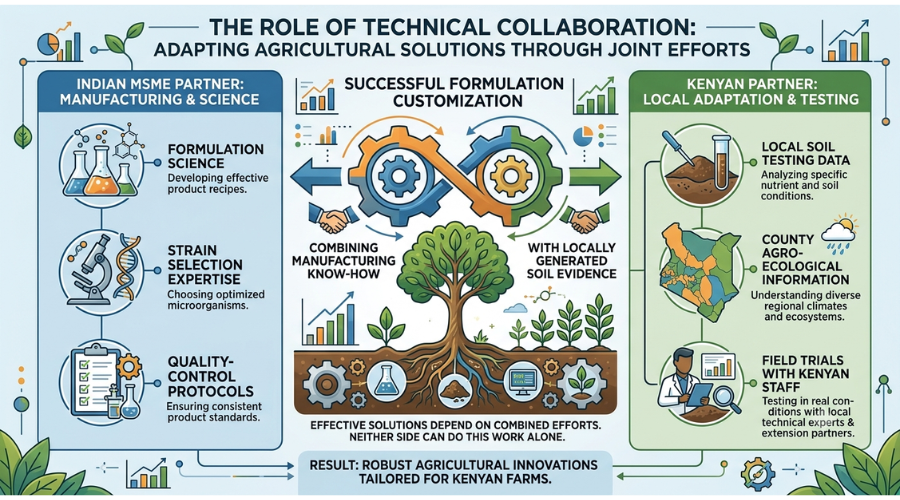
An experienced Indian MSME technical partner typically contributes formulation science, strain selection expertise, and quality-control protocols, while adaptation to Kenyan conditions requires local soil testing data, county agro-ecological information, and field trials conducted with Kenyan technical staff or extension partners. Neither side can do this work alone — successful formulation customization depends on combining manufacturing know-how with locally generated soil evidence.
Regulatory and feasibility caution
Soil chemistry, pH, and nutrient-deficiency patterns vary at the farm level even within the same county; the county-level figures cited here are aggregated averages and should not be treated as applicable to any specific site. This article does not constitute agronomic, regulatory or investment advice. Any formulation or liming decision should be based on independent local soil testing, and any manufacturing or product-registration decision should be verified against current requirements from Kenya’s fertilizer regulatory authorities.
Looking to develop a soil-specific organic fertilizer or biofertilizer formulation for your target region in Kenya?
Gondwana Treasures helps connect Kenyan and East African investors with Indian MSME technical partners experienced in formulation science, strain selection, and quality-control systems — supporting locally adapted product development rather than one-size-fits-all recipes. Contact Gondwana Treasures to discuss your target county, soil conditions, and technical collaboration needs.