
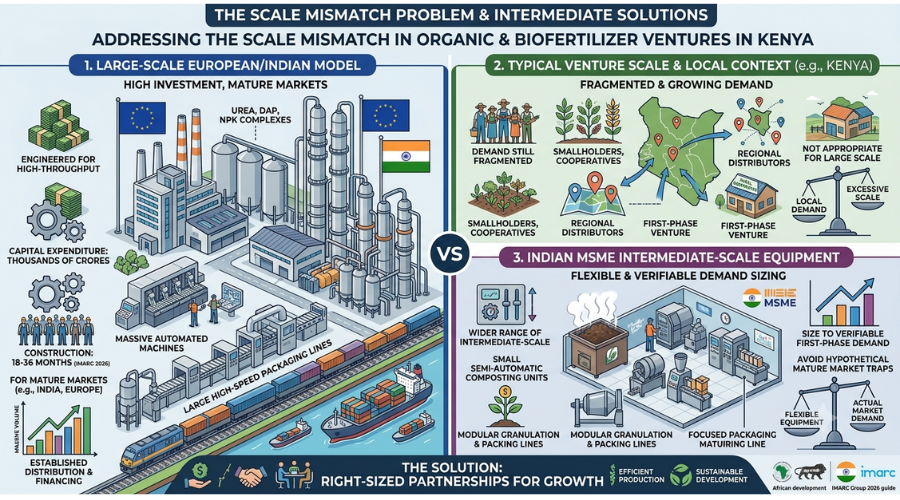
Kenyan investors setting up an organic fertilizer or biofertilizer facility face a genuine equipment decision: Indian machinery vs. European machinery for a Kenya-based factory. The right answer depends less on brand reputation and more on matching plant scale, automation level, and capital outlay to actual local feedstock volumes and market demand.
The scale mismatch problem
European fertilizer and process machinery is generally engineered for large, fully automated, high-throughput operations designed for mature markets with established distribution and financing infrastructure. India’s own large-scale urea, DAP and NPK complexes require capital expenditure running into thousands of crores and construction timelines of 18–36 months, according to IMARC Group’s 2026 industry guide on fertilizer plant setup in India. That scale of investment is generally not appropriate for a first-phase organic or biofertilizer venture in Kenya, where demand is real but still fragmented across smallholders, cooperatives, and regional distributors.imarcengineering
Indian MSME machinery manufacturers, by contrast, offer a much wider range of intermediate-scale equipment — from small semi-automatic composting units to larger granulation and packing lines — allowing an investor to size the plant to first-phase, verifiable demand rather than a hypothetical mature market.
Manufacturing scale is not the only variable
The choice is not simply “cheap Indian equipment vs. expensive European equipment.” Three distinct considerations should guide the decision:
- Bulk processing equipment (composting, granulation, drying, packing) — where mid-scale, semi-automated Indian equipment is widely available and can be phased in as volumes grow.
- Precision/quality-control equipment (fermentation vessels, microbial culture systems, laboratory testing) — where the specification and contamination-control standard matters more than country of origin; premium equipment may be justified here regardless of source.
- Maintenance and technical support ecosystem — mid-scale Indian equipment is generally designed for markets with power-reliability and spare-parts-availability constraints similar to Kenya’s, which can matter more over a plant’s operating life than headline machine cost.
Distinguishing manufacturing, blending and packaging needs
A pure blending or packaging-only operation (combining or repackaging already-processed organic or microbial inputs) requires substantially simpler equipment than a full manufacturing line converting raw feedstock into finished product. Investors should clarify which activity they intend to operate before sizing equipment, since blending/packaging lines typically involve materially lower capital outlay than full composting, fermentation, or granulation manufacturing systems.
A phased approach to capital planning
Rather than committing to a single large installation, a Kenyan JV can plan equipment acquisition in stages:
- Pilot/demonstration phase — small-scale composting or biofertilizer unit sized to verified local feedstock and a limited number of priority crops.
- Regional scale-up — addition of granulation, enrichment or packing capacity once demand and distributor relationships are established.
- Multi-county expansion — further production lines added incrementally as verified sales data supports the investment.
This phased model reduces the risk of importing equipment sized for a market that has not yet been proven, whether that equipment originates from India, Europe, or elsewhere.
Regulatory and feasibility caution
Equipment costs, specifications, and supplier terms change frequently and vary by exact configuration, capacity, and import conditions. The cost figures cited above are indicative marketplace listings only and should not be treated as firm quotations or as representative of any specific investment outcome. This article does not constitute engineering, financial, or investment advice. Prospective investors should obtain direct, itemized quotations from shortlisted equipment suppliers, verify import duty and clearance costs with Kenyan customs authorities, and commission an independent, site-specific feasibility study before committing capital to any machinery purchase.
Deciding on the right equipment scale for your Kenyan organic fertilizer or biofertilizer facility?
Gondwana Treasures helps connect Kenyan and East African investors with Indian MSME machinery and technology partners experienced in right-sizing plant equipment to local feedstock and market realities. Contact Gondwana Treasures to discuss your target plant scale, product category, and equipment requirements.