
A well-structured Indo-African joint venture protects both parties long before any dispute arises — and the two clauses that matter most in an organic fertilizer or biofertilizer manufacturing partnership are equity/governance structure and intellectual property protection.
Choosing the right JV structure
Cross-border joint ventures are generally structured as either an equity JV (a new legal entity, typically a private limited company, in which both parties hold shares) or a contractual JV (no separate entity; parties perform defined obligations and share revenue under a contract governed by general contract law). Most manufacturing partnerships — including fertilizer and biofertilizer plants — favor the equity JV route because it creates a single operating entity for licensing, employment, and asset ownership, provides limited liability protection matching each partner’s capital contribution, and offers clearer governance through a board of directors.
Equity contribution: matching capital to actual roles
A typical JV agreement documents each partner’s contribution explicitly — cash, assets, land, equipment valuation, or “sweat equity” for technical expertise — and specifies the resulting shareholding percentage. Profit allocation is usually proportional to equity, though parties can agree to a different split (for example, unequal profit-sharing despite equal equity) if explicitly stated in the agreement.gotredflags
For an Indian MSME–African investor structure, a common framework separates contribution type from equity percentage:
| Partner | Typical contribution | Equity consideration |
|---|---|---|
| Indian MSME (technical partner) | Formulation know-how, machinery specification, commissioning support, staff training, licensed IP | Often valued as sweat equity or licensing fee rather than direct cash, requiring careful valuation and documentation |
| African investor (capital/local partner) | Cash, land, working capital, local registration, market access | Typically the majority cash contributor, especially where land ownership restrictions apply |
Kenya’s foreign ownership landscape — know the boundaries first
Before structuring equity, confirm what your target country actually permits. Kenya’s Nairobi Securities Exchange does not restrict foreign ownership of listed companies, and general manufacturing is largely open to foreign investment, according to the U.S. State Department’s 2025 Investment Climate Statement. However, sector-specific restrictions do exist elsewhere in Kenyan law: mineral dealership licenses require at least 60% Kenyan citizen shareholding, insurance company foreign capital is capped at two-thirds, and construction contractors are subject to local-content rules if more than 50% foreign-owned.
Critically for land-based manufacturing: Kenya’s Constitution prohibits foreigners or foreign-owned firms from owning freehold interest in land in Kenya. This is why the JV structure matters — if the African partner holds the land directly (or the JV entity, once properly incorporated as a Kenyan company, holds leasehold rights), the venture can proceed without breaching this restriction, whereas a foreign entity attempting direct freehold land ownership cannot.
A foreign investor turning over control of a Kenyan corporation to a foreign company also requires a Central Bank permit under older but still-cited investment regulations, underscoring that governance and control structuring deserves early legal review, not late-stage correction.
IP protection: license, don’t assign
The single most important principle for the Indian technical partner is this: license your intellectual property to the JV entity — do not transfer ownership. This distinction matters because:
- A licensed IP arrangement lets the Indian MSME retain ownership of its formulation know-how, strain cultures, or process technology while granting defined usage rights to the JV.
- Licenses should specify whether rights are exclusive or non-exclusive, the territory covered, the royalty or fee structure, and the license term.
- Any improvements or new formulations developed during the JV’s operation (“foreground IP”) should be explicitly addressed — standard practice is that new IP created within JV scope belongs to the JV, while background IP contributed by each party remains that party’s property.
Registering IP locally strengthens protection
Filing trademarks, patents, and designs directly in the country of operation — under that country’s own intellectual property laws — provides stronger local enforcement than relying solely on Indian registrations. This is a standard recommendation for any foreign technical partner licensing formulation or brand IP into an African market.
Essential JV agreement clauses for a fertilizer manufacturing venture
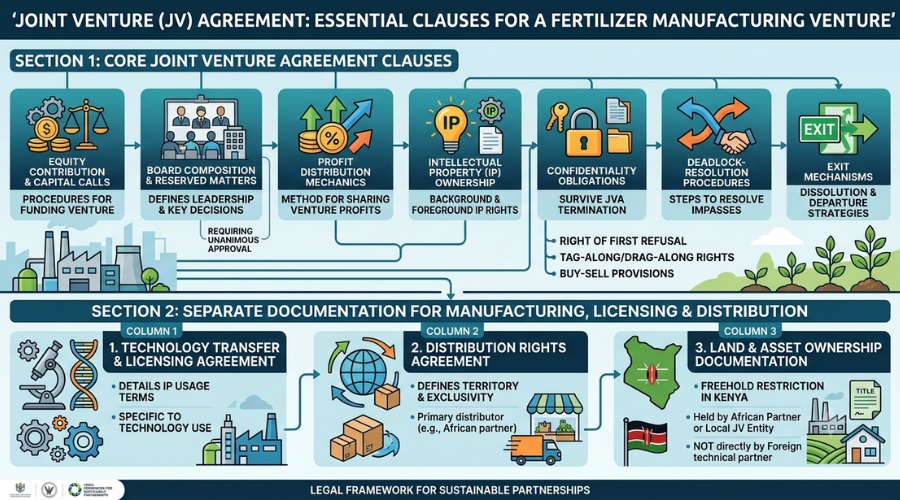
A properly drafted JV agreement should address, at minimum: equity contribution and capital-call procedures; board composition and reserved matters requiring unanimous approval; profit distribution mechanics; background and foreground IP ownership and licensing terms; confidentiality obligations that survive termination; deadlock-resolution procedures; and exit mechanisms such as right of first refusal, tag-along/drag-along rights, and buy-sell provisions.
Manufacturing, licensing and distribution require separate documentation
- Manufacturing/technology transfer: typically documented through a separate technology transfer or licensing agreement alongside the core JVA, detailing IP usage terms.
- Distribution rights: should be defined separately from IP licensing, specifying territory and exclusivity if the African partner is also the primary distributor.
- Land and asset ownership: given Kenya’s freehold restriction on foreign ownership, land should typically be held by the African partner or by the properly incorporated local JV entity, not directly by the foreign technical partner.
Regulatory and feasibility caution
Foreign ownership rules, land restrictions, and JV governance requirements vary by country and are subject to change; the Kenya-specific rules cited here do not necessarily apply to Tanzania, Uganda, Rwanda, or other markets. This article does not constitute legal advice. Any joint venture structure, equity split, IP licensing arrangement, or land-holding mechanism should be reviewed by qualified legal counsel in both India and the target African jurisdiction before signing any binding agreement.
Structuring a joint venture between your organization and an Indian MSME for fertilizer or biofertilizer manufacturing?
Gondwana Treasures helps facilitate initial B2B coordination between African investors and Indian technical partners — supporting introductions, scoping discussions, and connections to appropriate legal and technical advisors for equity and IP structuring. Contact Gondwana Treasures to discuss your proposed partnership structure and technical collaboration needs.