
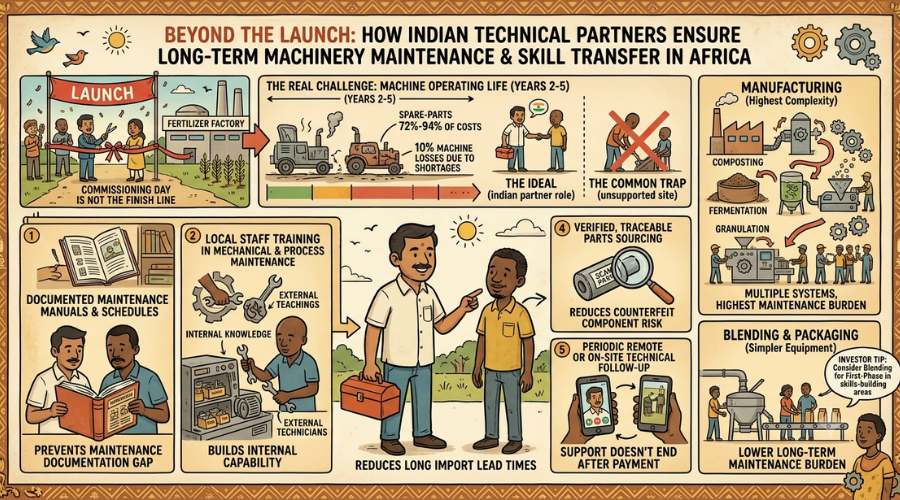
Commissioning day is not the finish line for a fertilizer or biofertilizer factory — it’s the starting point for a much longer challenge: machinery maintenance and skill transfer in Africa, sustained over the equipment’s full operating life.
Why post-launch support is the real risk
Investors often budget carefully for plant construction and commissioning but underestimate what happens in year two, three, or five. Across African industrial sectors, spare-parts consumption typically accounts for 72% to 94% of total maintenance costs, and machine utilization losses of around 10% due to spare-parts shortages have been documented in industrial case studies compiled by UNIDO. In the water infrastructure sector, an average of 30% of handpumps across Africa are non-functional at any given time — in some areas over 50% — largely due to spare-parts unavailability, according to World Bank research. While these figures come from different sectors, they illustrate a consistent regional pattern: equipment failure is rarely about the initial installation — it’s about what happens afterward.
The infrastructure behind the infrastructure
Several structural issues make post-commissioning support genuinely difficult in Africa, and any serious technical partnership must plan around them rather than assume they don’t apply:
- Long import lead times: a component obtainable within two days in Europe can take up to two months to reach Africa, according to Caterpillar’s documented rationale for its African component-exchange programme, due to market size and transport infrastructure.
- Fragmented spare-parts distribution: research on Sub-Saharan African spare-parts logistics found that dominance of informal, non-standardized suppliers results in service inconsistency and poor consumer confidence.
- Counterfeit component risk: SKF has documented cases of counterfeit bearings failing catastrophically within months of installation, causing secondary damage to connected machinery. Authorities have seized industrial-scale counterfeit shipments, underscoring that non-genuine parts are a real operational risk, not a hypothetical one.
- Skills gaps in industrial maintenance: a UNIDO-compiled review of human resources development in industrial maintenance across African countries — including Kenya and Tanzania — identified persistent gaps in workshop infrastructure, spare-parts inventory management, and specialized technical training.
What genuine technical partnership requires
Given these realities, a credible Indian MSME technical partnership cannot end at commissioning. It should be structured to include:
| Support element | What it addresses |
|---|---|
| Documented maintenance manuals and schedules | Prevents the “no proper maintenance documentation” gap identified in African engineering-faculty case studies |
| Local staff training in mechanical and process maintenance | Builds internal capability rather than permanent dependence on external technicians |
| Defined critical spare-parts inventory list | Reduces exposure to long import lead times for the specific components most likely to fail first |
| Verified, traceable parts sourcing | Reduces counterfeit-component risk documented across African industrial supply chains |
| Periodic remote or on-site technical follow-up | Addresses the common failure pattern where support ends once the invoice is settled |
Precedents for structured skill transfer
Structured, sustained technical training is not new to India–Africa industrial relationships. Tata Motors South Africa, for example, prioritized training and skills transfer for its South African workforce, establishing dedicated training facilities as part of a long-term operational commitment rather than a one-time handover. In a different sector, SKF conducted an eight-day, on-site training program for South African sugar-industry technicians covering precision alignment and basic bearing maintenance during planned downtime — illustrating how structured, scheduled skill-building can be embedded into a facility’s operating calendar rather than treated as an afterthought. Know more…
Manufacturing, blending, and packaging: different maintenance intensity
A full manufacturing line (composting, fermentation, granulation) carries the highest maintenance complexity, given multiple mechanical and process-control systems. A blending/packaging operation has a simpler equipment footprint and correspondingly lower long-term maintenance burden — a relevant consideration for investors weighing which activity to prioritize in a first-phase facility, particularly where local technical skills are still being built.
What African partners should ask before signing a JV agreement
- Does the technical partner provide documented maintenance schedules and training materials in addition to installation?
- What is the defined critical spare-parts list, and what is the realistic import lead time for each item?
- Is there a verified, traceable sourcing channel for replacement parts to avoid counterfeit risk?
- What ongoing technical support — remote or on-site — is included beyond the commissioning period, and for how long?
Regulatory and feasibility caution
Maintenance costs, spare-parts availability, and equipment downtime vary significantly by machinery type, site location, and supplier arrangement; the figures cited here illustrate general regional patterns and should not be treated as predictions for any specific project. This article does not constitute engineering, procurement, or investment advice. Prospective investors should negotiate clearly defined maintenance, training, and spare-parts terms as part of any technology-transfer or joint-venture agreement, and should verify supplier authenticity independently before procurement.
Planning a fertilizer or biofertilizer manufacturing venture and want to ensure your technical partnership extends beyond commissioning day?
Gondwana Treasures helps connect African investors with Indian MSME technical partners who provide structured maintenance planning, staff training, and long-term technical support — not just initial installation. Contact Gondwana Treasures to discuss your project’s maintenance, training, and spare-parts requirements.