
Before committing capital to any organic fertilizer or biofertilizer joint venture, African investors need a clear, defensible process for vetting Indian MSME technical partners — one grounded in verifiable government records, not supplier-provided documents alone.
A note on the word “guarantee” in this topic: no due-diligence process can guarantee outcomes. What a structured verification process can do is substantially reduce risk by confirming legal identity, registration status, and production capability before an agreement is signed.
Start with legal identity — verify, don’t trust
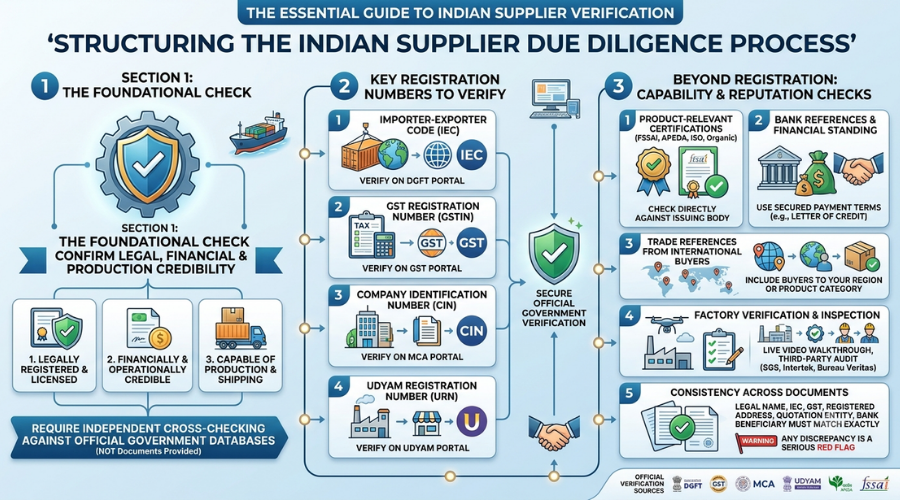
The starting point for any Indian supplier verification is confirming three things: that the business is legally registered and licensed, that it is financially and operationally credible, and that it can actually produce and ship what it promises. This requires independent cross-checking against official government databases, not reliance on documents the supplier provides.
Key registration numbers to verify
| Document | What it confirms | Where to verify independently |
|---|---|---|
| Importer-Exporter Code (IEC) | Legal authorization to export from India — mandatory for any genuine exporter | DGFT portal (dgft.gov.in) |
| GST Registration Number (GSTIN) | Active, tax-compliant business operating legitimately in India | GST portal (gst.gov.in) |
| Company Identification Number (CIN) | Confirms registered company status if claiming Private/Public Limited structure | Ministry of Corporate Affairs portal (mca.gov.in) |
| Udyam Registration Number (URN) | Confirms genuine MSME classification (Micro/Small/Medium), enterprise name, and registration date | Official Udyam portal (udyamregistration.gov.in) |
Practical caution: Udyam registration is self-declared and free to obtain, requiring only Aadhaar and PAN details with no mandatory document upload. This means Udyam status confirms legal MSME classification — it does not, by itself, verify production capability, financial strength, or export experience. Additional checks are required.udyamregistration.gov
Beyond registration: capability and reputation checks
A structured Indian supplier due-diligence process should also verify:
- Product-relevant certifications (FSSAI, APEDA registration for agricultural exporters, ISO, organic certification) checked directly against the issuing body, not just the copy supplied by the seller
- Bank references and financial standing, using secured payment terms such as a Letter of Credit until trust is established through completed transactions
- Trade references from existing international buyers, ideally including buyers who have received shipments to your region or product category
- Factory verification — through a live video walkthrough, third-party factory audit, or inspection agency visit (e.g., SGS, Bureau Veritas, Intertek) — to confirm the supplier genuinely operates the claimed production facility
- Consistency across documents — legal company name, IEC, GST details, registered address, quotation entity, and bank beneficiary name should all match exactly; any discrepancy is a serious red flag
Common red flags in supplier verification
Buyer due-diligence guides consistently flag several warning patterns worth checking explicitly: a mismatch between the quoting/invoicing entity and the bank beneficiary name; reluctance to provide a factory address, production capacity details, or evidence of recent production; unverifiable or non-existent certifications when checked against the issuing authority; and an inability to provide references from prior international buyers.
A staged verification approach for African investors
- Document collection — request IEC, GSTIN, CIN (if applicable), Udyam certificate, and relevant product certifications
- Independent cross-check — verify each number directly on its respective government portal, not from documents alone
- Trade reputation check — request and follow up on references from existing buyers, and review any documented export history
- Capacity and capability verification — confirm production facility, machinery, and process through video walkthrough or third-party factory audit.
- Sample order before scaling — test a sample shipment and, where feasible, independently laboratory-test the product before committing to full commercial volumes or a manufacturing JV
Manufacturing, blending, and technical-collaboration roles require different verification depth
A partner providing full manufacturing technology transfer (plant design, formulation, commissioning) warrants the most rigorous verification — including factory audits and reference checks with prior JV or technology-transfer clients. A partner providing only product sourcing or blending inputs may warrant a lighter but still document-verified process. A pure distribution relationship with no technical collaboration component carries the lowest verification burden, focused mainly on product certification and shipment history.
Regulatory and feasibility caution
Registration verification confirms legal status and classification; it does not guarantee production quality, financial solvency, or contractual performance. Certification and registration requirements are subject to change, and verification steps described here reflect current Indian government portals as of this writing. This article does not constitute legal, financial, or investment advice. African investors should conduct independent due diligence — including legal review of contracts and, where appropriate, third-party factory audits — before entering any manufacturing, technology-transfer, or joint-venture agreement.
Evaluating a potential Indian MSME technical partner for your fertilizer or biofertilizer venture?
Gondwana Treasures supports African investors with initial B2B coordination and helps facilitate introductions to Indian MSMEs with verifiable registration and production credentials. Contact Gondwana Treasures to discuss your proposed partnership and the verification support you need.