
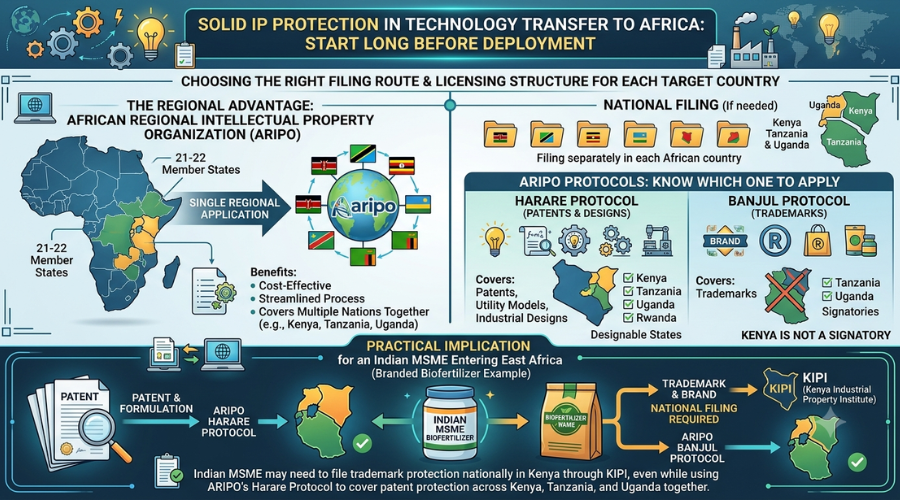
Solid IP protection in technology transfer to Africa starts long before any formulation or machinery design crosses the border — it begins with choosing the right filing route and licensing structure for each target country.
Africa’s IP landscape is regional, not fragmented country-by-country
Unlike filing separately in every African country, the African Regional Intellectual Property Organization (ARIPO) allows an applicant to designate multiple member states through a single regional application. ARIPO currently has 21-22 member states, including Kenya, Tanzania, Uganda, Rwanda, and Zambia — most of them English-speaking Eastern and Southern African countries. This regional mechanism is directly relevant for an Indian MSME entering East Africa, since it can cover Kenya, Tanzania, and Uganda together rather than filing three separate national applications. Click to know more…
Two separate protocols cover patents and trademarks
ARIPO administers its patent and trademark protections through distinct protocols, and an applicant must understand which one applies to their IP:
| Protocol | Covers | Key East African signatories |
|---|---|---|
| Harare Protocol | Patents, utility models, industrial designs | Kenya, Tanzania, Uganda, Rwanda are all designable states |
| Banjul Protocol | Trademarks | Tanzania and Uganda are signatories; Kenya is not currently among the 13 Banjul Protocol states |
Practical implication: an Indian MSME protecting a branded biofertilizer product name may need to file trademark protection nationally in Kenya through the Kenya Industrial Property Institute (KIPI), even while using ARIPO’s Harare Protocol to cover patent protection for the underlying formulation or process across Kenya, Tanzania, and Uganda together.
How the ARIPO filing process actually works
For patents, an applicant files ARIPO Form 3 along with a description, claims, drawings (if any), and an abstract, designating at least one contracting state. For trademarks under the Banjul Protocol, the applicant files Form M1, with online filing offering a 20% fee reduction; designated states then have 9-12 months to conduct their own substantive examination under their national laws before a mark proceeds to publication and a three-month opposition window.
Representation requirement: if the Indian MSME applicant has no ordinary residence or principal place of business in an ARIPO contracting state, representation by a local trademark agent or legal practitioner is mandatory when filing. This makes early engagement with a regional IP agent a practical necessity, not an optional convenience.
National institutions still matter
Each ARIPO member state maintains its own IP institution for matters outside ARIPO’s regional scope. Kenya, for example, splits responsibility between the Kenya Copyright Board (KECOBO) for copyright and the Kenya Industrial Property Institute (KIPI) for patents, trademarks, and industrial designs. Uganda’s equivalent is the Uganda Registration Services Bureau (URSB), and Tanzania mainland is covered by BRELA, with Zanzibar maintaining a separate registry. An Indian MSME’s legal advisor should confirm which national office applies for any protection ARIPO’s regional filing doesn’t cover.
Contractual protection matters as much as registration
Registration protects IP against third parties, but the technology-transfer or licensing agreement itself is what protects the Indian MSME against its own JV partner. Standard protective clauses found in Indian technology-transfer agreements include:
- Confidentiality/secrecy clauses restricting the licensee from divulging inventions, drawings, designs, or specifications to third parties.
- Non-partibility provisions preventing the licensee from making unauthorized copies of the technology.
- Restrictions on further disclosure, limiting information sharing to specifically authorized employees only.
- Consent requirements before any assignment of the licensed technology to a third party.
These clauses, according to research on India’s own technology-transfer practices, are the primary mechanism by which technology licensors historically retain control over their intellectual property even after transfer.
License, don’t assign — and separate background from foreground IP
The IP the Indian MSME brings into the partnership (formulation know-how, existing strain cultures, proprietary processes) should be licensed to the African JV entity or distributor, not assigned outright. Any new improvements developed jointly during the collaboration (“foreground IP”) should be addressed explicitly in the agreement — standard practice treats foreground IP as belonging to the entity that funded or directed its development, while each party’s pre-existing background IP remains their own property.
Manufacturing, licensing, and distribution require distinct IP documentation
- Manufacturing/technology transfer: requires a dedicated technology-transfer or license agreement specifying scope, territory, and confidentiality terms, separate from any broader JV agreement.
- Distribution: brand/trademark licensing for distribution rights should be documented separately from any patent or process-technology license.
- Blending/formulation collaboration: where an African partner adapts an Indian formulation locally, the agreement should explicitly define ownership of any resulting locally adapted formula.
Regulatory and feasibility caution
IP protection scope, protocol membership, and registration procedures vary by country and are subject to change; the ARIPO and national-office details cited here reflect general regional frameworks and may not capture every recent legislative update. This article does not constitute legal advice. Any technology-transfer, licensing, or trademark-filing strategy should be reviewed by qualified IP counsel with experience in both India and the specific African jurisdictions involved before any formulation, brand, or process technology is shared with a prospective partner.
Preparing to transfer formulation know-how or licensed technology to an African manufacturing partner?
Gondwana Treasures helps facilitate initial B2B coordination between Indian MSMEs and African partners, including connections to appropriate legal advisors for IP protection and technology-transfer documentation. Contact Gondwana Treasures to discuss your technology-transfer and IP protection needs.