
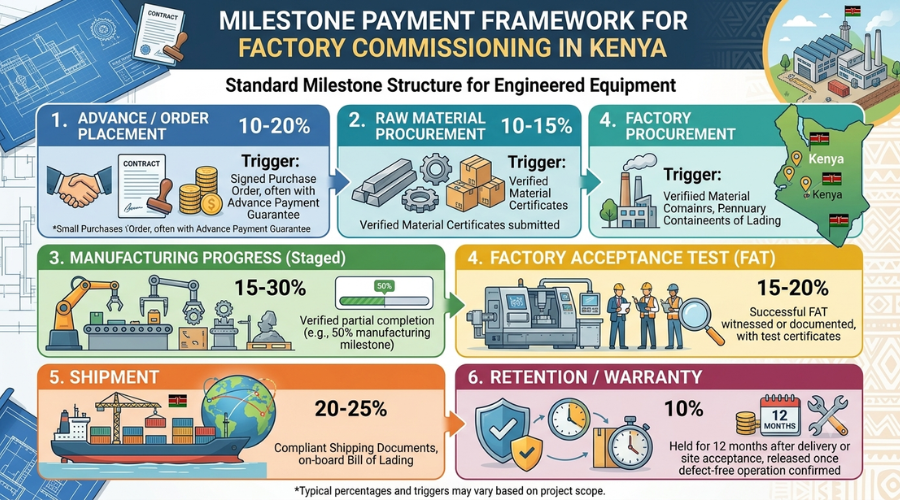
Paying an equipment supplier or EPC contractor in one or two large lump sums is one of the most common and avoidable risks in cross-border factory projects. A properly structured milestone payment framework for factory commissioning in Kenya ties each payment tranche to a verified, physical deliverable — protecting the investor’s capital at every stage.
Why milestone structures exist
Milestone-based payment schedules divide the total contract value into smaller payments released only when specific, verifiable project stages are achieved — such as design approval, material procurement, factory testing, shipment, and site acceptance — rather than on a calendar basis. This structure protects the buyer because each payment is tied to a tangible, inspectable event, not a promise or a date on a calendar.
Standard milestone structure for engineered equipment
For custom-fabricated industrial equipment — the category most biofertilizer and organic fertilizer machinery falls into — a typical milestone schedule follows a progressive pattern rather than a simple 50/50 split:
| Milestone | Typical % of contract value | Trigger event |
|---|---|---|
| Advance/order placement | 10-20% | Signed purchase order, often with an advance payment guarantee |
| Raw material procurement | 10-15% | Verified material certificates submitted |
| Manufacturing progress | 15-30% (often staged) | Verified partial completion, e.g., 50% manufacturing milestone |
| Factory Acceptance Test (FAT) | 15-20% | Successful FAT witnessed or documented, with test certificates |
| Shipment | 20-25% | Compliant shipping documents, on-board bill of lading |
| Retention/warranty | 10% | Held for 12 months after delivery or site acceptance, released once defect-free operation is confirmed |
For a full turnkey plant (EPC) commissioning
Where an Indian technical partner is contracted for full engineering, procurement, and construction (EPC) rather than equipment supply alone, milestone payments typically span the entire project lifecycle: design/engineering approval, equipment procurement placement, civil works commencement, mechanical completion, commissioning, performance guarantee, and final acceptance — each verified by a specific completion certificate before payment release. A defect-liability retention (often around 10-12.5% of contract value) is commonly withheld until a defined defect-liability period — frequently 12 months from commissioning or 18 months from preliminary acceptance — has passed without unresolved issues.
Payment instruments that add protection
The milestone structure defines when to pay; the payment instrument defines how safely. Common instruments for Indian machinery imports include:
- Letter of Credit (LC): the buyer’s bank pays the exporter only after compliant shipping and inspection documents are presented, meaning payment and document verification happen simultaneously — widely regarded as the safest structure for new trading relationships.
- Telegraphic Transfer (T/T) with staged releases: a deposit to start production, a payment after factory acceptance testing, and a final balance on shipment or site commissioning — offering less protection than an LC but simpler administration for established relationships.
- Advance Payment Guarantee (APG): a bank guarantee from the supplier’s side that refunds the advance if the supplier fails to deliver, often paired with the initial milestone payment on larger orders.
What documentation to require at each milestone
Every milestone payment should require the supplier to submit defined evidence before release — inspection reports, material test certificates, factory acceptance test reports with photographs, and shipping documents — verified either by the buyer’s own team or an independent third-party inspection agency before authorizing payment.
Manufacturing, blending, and packaging equipment carry different payment risk
A full manufacturing line (composting, fermentation, granulation equipment) involves higher-value, longer-lead-time custom fabrication, making a detailed multi-stage milestone structure essential. Simpler blending/packaging equipment, being more standardized and lower-cost, may reasonably use a shorter 2-3 stage structure (advance, pre-shipment, final) without the full progressive schedule needed for custom industrial equipment.
Regulatory and feasibility caution
Payment terms, retention percentages, and milestone structures vary by supplier, equipment type, and contract negotiation, and the ranges cited here reflect general industry practice rather than a fixed standard applicable to every transaction. This article does not constitute legal or financial advice. Any milestone payment framework, letter of credit terms, or EPC contract structure should be reviewed by qualified legal and trade-finance advisors before signing, and independent third-party inspection should be arranged for major milestone verifications wherever contract value warrants it.
Structuring payment terms for an upcoming fertilizer or biofertilizer factory project in Kenya?
Gondwana Treasures helps African investors coordinate with Indian MSME equipment suppliers on staged, milestone-based payment structures that align capital release with verified project progress. Contact Gondwana Treasures to discuss your project scope and payment structuring needs.