
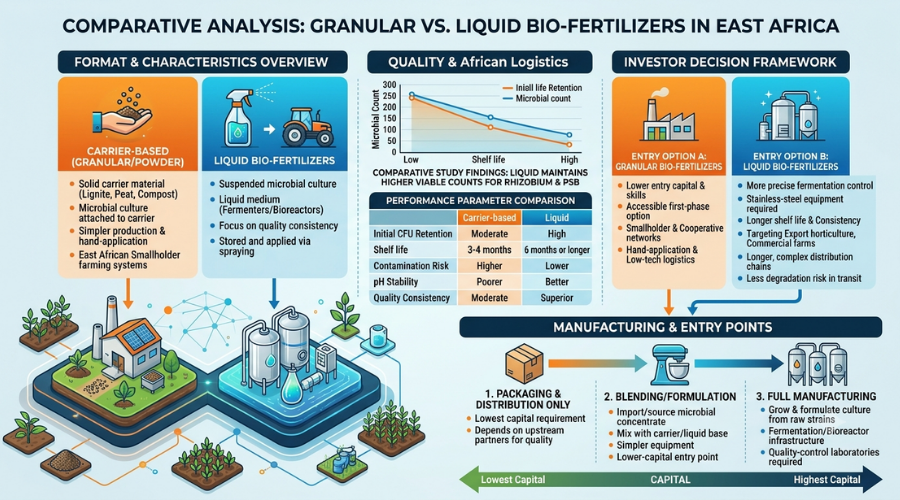
Choosing between a granular vs. liquid biofertilizer production line is one of the first technical decisions an African investor must make — and it shapes capital cost, shelf life, distribution logistics, and target customer for years to come.
Two different products, two different businesses
Granular (carrier-based) and liquid biofertilizers are not simply packaging variants of the same product — they are distinct formulations with different production processes, storage requirements, and customer use-cases. Before comparing ROI, it helps to understand what separates them technically.
Carrier-based (granular/powder) biofertilizers
These use a solid carrier material (often lignite, peat, or compost-based) to hold the microbial culture. They are generally simpler to produce, transport, and apply by hand — a relevant factor across most East African smallholder farming systems.
Liquid biofertilizers
These suspend the microbial culture in a liquid medium, typically produced using fermenters or bioreactors, and are increasingly favored where quality consistency and storage stability matter to the buyer.
Quality and shelf-life differences matter for African logistics
A comparative study on carrier-based versus liquid biofertilizer formulations found that liquid biofertilizers maintained higher viable microbial counts for both Rhizobium and phosphate-solubilizing bacteria (PSB) for up to six months, with negligible contamination — while carrier-based formulations showed shorter shelf life, faster decline in microbial population, higher moisture content, and greater susceptibility to contamination. Click to know more…
| Parameter | Carrier-based (granular) | Liquid |
|---|---|---|
| Initial CFU retention | Moderate | High |
| Shelf life | 3–4 months | 6 months or longer |
| Contamination risk | Higher | Lower |
| pH stability | Poorer | Better |
| Overall quality consistency | Moderate | Superior |
Source: comparative assessment of biofertilizer formulations, published in a peer-reviewed agricultural chemistry journal. Click to Read More…
Why this matters for East Africa: longer shelf life and lower contamination risk directly reduce the risk of product spoilage during transport across poor rural road networks and extended distributor-to-farmer supply chains common in Kenya, Tanzania, and Uganda — though actual field performance still depends on storage temperature and handling at each stage.
Capital cost comparison: what Indian equipment listings show
Indian machinery suppliers list a wide range of both granular and liquid biofertilizer plant configurations, illustrating meaningfully different capital entry points:
| Plant type | Indicative cost range (India-listed, INR) |
|---|---|
| Small carrier-based/granular bio-fertilizer unit | Rs. 1.5–7.9 lakh, per multiple IndiaMART/TradeIndia listings |
| Mid-scale granular processing line (2–20 TPD) | Rs. 7.9–25 lakh, per IndiaMART listings |
| Small liquid biofertilizer plant (150L–1,000L) | Rs. 8.5–17.5 lakh, per Fermex Solutions and Real Ions Technologies listings |
| Mid-scale liquid plant (500L–10,000L per batch) | Rs. 10–50 lakh, per Labh Group and other supplier listings |
| Large industrial fermenter/bioreactor systems | Rs. 5.5 lakh–40+ lakh depending on capacity, per Dhruv Fabrotech listings |
These figures are indicative marketplace listings, not fixed quotations, and do not include freight, import duty, installation, or site-specific costs relevant to an African facility.
Which line suits which investor?
Granular/carrier-based lines generally require lower entry capital and simpler operating skills, making them a more accessible first-phase option for investors targeting smallholder and cooperative distribution networks where hand-application and low-tech logistics dominate.
Liquid biofertilizer lines require more precise fermentation control and stainless-steel equipment, but the resulting product’s longer shelf life and better quality consistency may suit investors targeting export-oriented horticulture, commercial farms, or markets with longer, more complex distribution chains — where product degradation during transit is a bigger business risk.
Manufacturing, blending, and packaging distinctions
- Full manufacturing (growing and formulating the microbial culture from raw strains) requires fermentation/bioreactor infrastructure and quality-control laboratories for either format.
- Blending/formulation (combining an imported or locally sourced microbial concentrate with a carrier or liquid base) requires simpler mixing and packaging equipment, and may be a lower-capital entry point for a first-phase African facility.
- Packaging and distribution only carries the lowest capital requirement but depends entirely on a reliable upstream manufacturing or blending partner for product quality.
Regulatory and feasibility caution
Biofertilizer registration, permitted microbial strains, and labeling requirements vary by country and are subject to change; verify current requirements with the relevant national fertilizer regulatory authority (e.g., Kenya’s Agriculture and Food Authority) before committing to either production format. Equipment costs, shelf-life outcomes, and product performance depend on formulation quality, storage conditions, and local climate, and cannot be guaranteed. This article does not constitute investment, engineering, or regulatory advice — commission an independent, site-specific feasibility study before selecting a production line.
Deciding between a granular or liquid biofertilizer production line for your African market?
Gondwana Treasures helps connect African investors with Indian MSME technical partners experienced in both carrier-based and liquid biofertilizer manufacturing — supporting formulation guidance, machinery selection, and commissioning coordination based on your target market and distribution model. Contact Gondwana Treasures to discuss your preferred format, target region, and technical collaboration needs.