
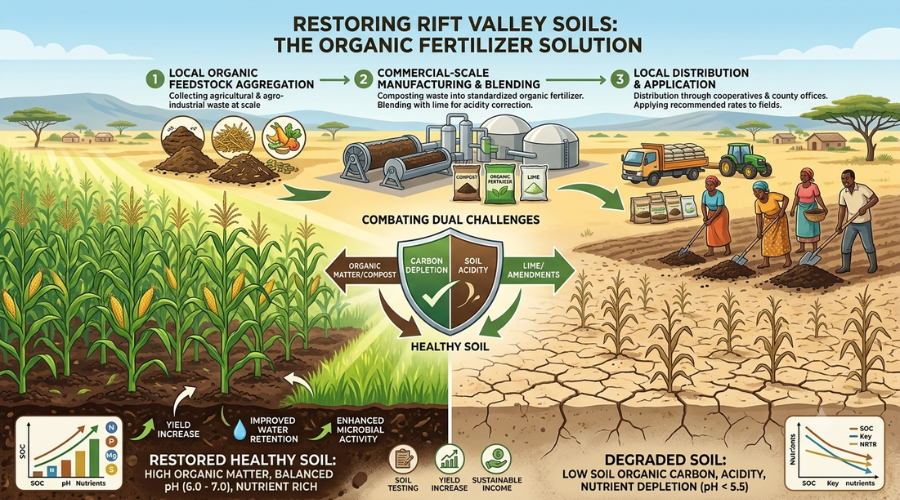
The evidence for mass-producing organic fertilizer for Rift Valley is not speculative — it comes from decades of documented soil-carbon and nutrient-depletion data across Kenya’s key cropping regions, and it points to a structural, ongoing input gap rather than a one-time need.
The scale of soil carbon loss is well documented
Long-term field experiments across four sites in Kenya, running for at least 16 years, found that continuous maize cropping without organic inputs causes soil organic carbon (SOC) losses averaging 2% per year — roughly 40% of initial SOC content lost over 19 years. This is not a localized problem: Cornell University research spanning 100-year chronosequence sites in western Kenya found more than two-thirds of native forest carbon was lost within a century of continuous cultivation, with rapid nutrient losses (nitrogen, phosphorus, potassium, calcium, magnesium) occurring within just 15-36 years of continuous cropping.
Across East Africa more broadly, soil organic matter in the region has dropped by an estimated 50-75% compared to pre-agricultural periods, according to research on push-pull farming systems in western Kenya. Know more…
Erosion compounds the nutrient problem
Beyond carbon depletion from cropping alone, Kenya loses topsoil at accelerated rates. National modelling found average soil erosion of approximately 5.5 tonnes per hectare per year under current land cover — roughly three times the rate under natural vegetation — equivalent to about 320 million tonnes of topsoil lost nationwide annually. This erosion carries away an estimated 8.8 million tonnes of soil organic carbon, 315,000 tonnes of nitrogen, and 110,000 tonnes of phosphorus every year, with the highest erosion rates concentrated in croplands and steepest in western Kenya’s high-rainfall, high-slope regions.
What this means for annual nutrient replacement needs
Kenyan maize crops extract substantial nutrients every growing season — over 40 kg of nitrogen, 8 kg of phosphorus, 40.6 kg of potassium, and 5.4 kg of sulfur per hectare, according to a review of Kenya’s soil infertility management practices. Yet farmers apply an average of just 43.25 kg of fertilizer per hectare per season nationally — a volume that falls well short of what continuous cropping actually removes from the soil. This gap between nutrient extraction and nutrient replacement is the structural driver behind sustained fertilizer demand, independent of any single season’s weather or price conditions.
Why farmyard manure alone can’t close the gap at farm level
Research consistently identifies farmyard manure as the most effective organic input for slowing SOC loss, outperforming crop residues, sawdust, and mineral nitrogen alone. However, the same research is explicit about the practical constraint: the manure application rates needed to meaningfully offset soil carbon losses — often exceeding 10 tonnes of dry matter per hectare per year — are “often not realistic for smallholder farmers in Africa” to produce or transport themselves. This is precisely the gap that commercial-scale organic fertilizer manufacturing is positioned to fill: aggregating and processing organic feedstock at a scale individual smallholders cannot replicate on-farm.
Soil acidity adds a second constraint layer
Compounding the carbon and nutrient loss, soil acidity below pH 5.5 now affects most of Kenya’s maize-growing regions, with 71% of sampled soils in one Rift Valley study showing pH levels below the range needed for optimal nitrogen and nutrient availability. This means organic fertilizer formulated for the region ideally needs to address both nutrient replenishment and acidity-related nutrient lock-up simultaneously, rather than nutrient content alone.
Comparing intervention approaches
| Approach | SOC loss outcome (19-year study) | Practical scalability for Rift Valley farmers |
|---|---|---|
| No organic/mineral input (control) | ~40% SOC loss | N/A — baseline degradation |
| Mineral N fertilizer alone | No significant reduction in SOC loss vs. control | Widely used but does not address carbon loss |
| Sawdust or maize stover (low-quality organic) | No significant reduction in most sites | Low cost but limited soil-building effect |
| Farmyard manure at scale (4 t C/ha/yr) | Loss limited to ~12% | Most effective, but volume requirements exceed typical smallholder production capacity |
| Commercially processed organic fertilizer/compost | Not directly studied at this specific rate, but built on same high-quality organic-matter principle | Enables consistent, higher-volume supply beyond what individual farms can produce |
Manufacturing, blending, and distribution roles in closing this gap
Manufacturing at commercial scale — composting agricultural and agro-industrial waste into a standardized organic fertilizer product — can supply volumes individual farms cannot produce internally. Blending/formulation can combine composted organic matter with lime or phosphate-rich amendments to address both carbon depletion and acidity simultaneously. Distribution through cooperatives and county-level agricultural offices can reach the smallholder farms where soil degradation is most severe but purchasing power for premium inputs is most limited.
Regulatory and feasibility caution
Soil degradation rates, nutrient depletion figures, and erosion estimates vary by specific location, farming system, and study methodology; the figures cited here represent research findings from specific study sites and modelling exercises, not guaranteed conditions at any particular farm or investment location. This article does not constitute agronomic, investment, or feasibility advice. Any organic fertilizer manufacturing investment targeting Rift Valley soil restoration should be grounded in an independent, site-specific soil assessment and feasibility study, and any product must meet current KEBS/KEPHIS registration requirements before commercial sale.
Considering a commercial-scale organic fertilizer manufacturing investment to address Rift Valley soil degradation?
Gondwana Treasures helps connect African investors with Indian MSME technical partners experienced in organic fertilizer formulation, composting technology, and machinery guidance suited to large-scale soil restoration objectives. Contact Gondwana Treasures to discuss your target region, feedstock sources, and technical collaboration needs.