
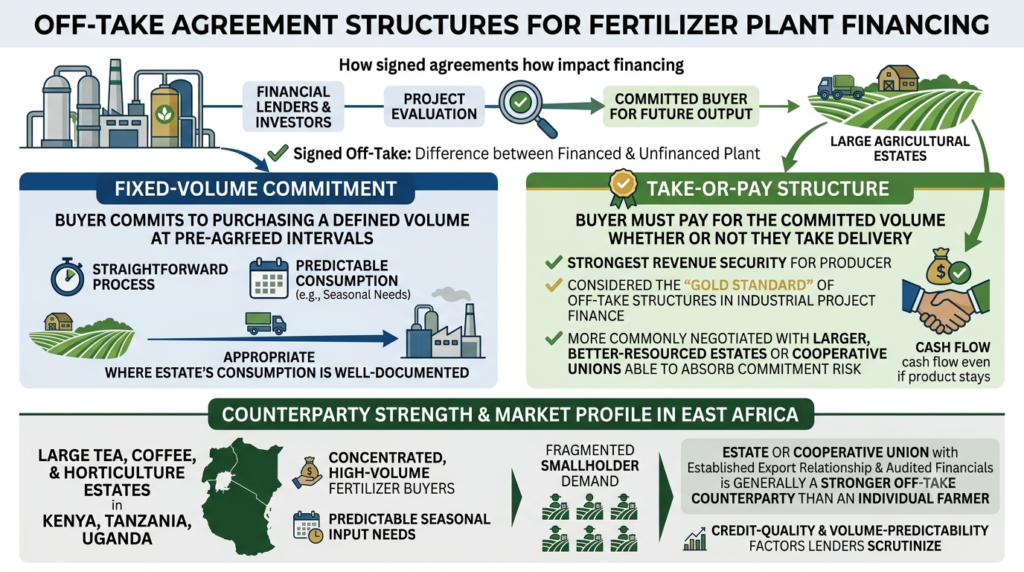
A signed off-take agreement can be the difference between a fertilizer plant that gets financed and one that doesn’t — because lenders and investors evaluate a new manufacturing project primarily on whether its future output already has a committed buyer.
Why off-take agreements matter more for new plants than existing ones
An off-take agreement is a binding contract in which a buyer commits to purchase a defined volume of a producer’s future output at agreed terms, converting uncertain future production into contracted, bankable revenue. For a project without an existing sales history — like a newly commissioned biofertilizer or organic fertilizer plant — this contracted revenue is often what makes lenders willing to extend project financing at all, since debt service capacity depends on revenue certainty, not projections. Know more…
What makes an off-take agreement genuinely bankable
Industry practitioners are explicit that not every signed document counts. A letter of intent from an unverified buyer “is not an off-take — it’s a conversation”. A bankable agreement requires several specific elements working together:
| Bankability factor | Why it matters |
|---|---|
| Counterparty credit quality | Lenders prefer investment-grade or otherwise verifiably creditworthy buyers; an unknown or unrated estate/cooperative weakens the agreement. |
| Contract tenor | Should match or exceed the loan repayment period the plant is seeking financing against. |
| Pricing mechanism | Fixed price, floor price, or index-linked pricing provides revenue predictability; pure market-price exposure with no floor undermines bankability. |
| Volume commitment | Defined minimum volumes, not just “available output,” give lenders confidence in projected cash flow |
| Termination and assignment rights | Lenders must be able to “step into” the agreement if the plant defaults; agreements without assignment rights are considered weaker |
Structuring the agreement: fixed-volume vs. take-or-pay
Two common structures suit different buyer relationships:
- Fixed quantity/volume commitment: the buyer commits to purchasing a defined volume at pre-agreed intervals — straightforward and appropriate where the estate’s fertilizer consumption is predictable and well-documented.
- Take-or-pay: the buyer must pay for the committed volume whether or not they take delivery, offering the strongest revenue security for the producer, and considered the “gold standard” of off-take structures in industrial project finance. This structure is more commonly negotiated with larger, better-resourced estates or cooperative unions able to absorb the commitment risk.
Key clauses a fertilizer off-take agreement should include
Based on standard commodity supply and off-take agreement practice, the contract should clearly define: exact product specification (nutrient content, formulation, packaging), volume commitment and measurement period, pricing formula and any review mechanism, delivery point and responsibility for transport, quality-testing procedures and remedies for non-compliant batches, term length and commencement conditions (often tied to commercial production start, not signing date), force majeure provisions, and termination/assignment rights protecting both the producer and any financing lender.
Why estates are logical first off-takers for new plants
Large tea, coffee, and horticulture estates in Kenya, Tanzania, and Uganda represent concentrated, high-volume fertilizer buyers with predictable seasonal input needs — a very different buyer profile from fragmented smallholder demand. An estate or cooperative union with an established export relationship and audited financials is generally a stronger off-take counterparty than an individual farmer, precisely because of the credit-quality and volume-predictability factors lenders scrutinize.
Manufacturing, blending, and distribution: off-take structures differ
A full manufacturing plant seeking project financing benefits most from a formal, long-tenor off-take agreement, since lenders will scrutinize the contract directly. A blending/packaging operation with lower capital requirements may operate successfully on shorter-term supply agreements without needing the same lender-driven rigor. Pure distribution arrangements are typically documented as ongoing supply agreements rather than formal off-take contracts, since no upstream production financing is usually at stake.
A practical sequencing note for new African fertilizer ventures
Because off-take negotiations happen before a plant is built, agreements should include clear conditions precedent — financing closure, regulatory permits, and a defined commercial-operation date — with explicit remedies if these milestones are missed. Negotiating the off-take agreement in parallel with securing KEBS/AFA registration and financing, rather than sequentially, can shorten the overall project timeline.
Regulatory and feasibility caution
Off-take agreement terms, buyer creditworthiness, and financing requirements vary significantly by project scale, buyer, and lender; the frameworks described here reflect general project-finance practice, not a guarantee of financing approval or buyer commitment for any specific venture. This article does not constitute legal, financial, or investment advice. Any off-take agreement should be negotiated with qualified legal and financial advisors, and should be structured alongside — not as a substitute for — an independent feasibility study and current regulatory compliance.
Seeking to secure anchor buyers or off-take agreements for a planned fertilizer or biofertilizer plant in East Africa?
Gondwana Treasures helps connect African investors and Indian MSME technical partners, supporting introductions and initial coordination that can inform your off-take and production planning discussions. Contact Gondwana Treasures to discuss your project’s target buyers and production scale.