
Certification requirements, not just farmer preference, are driving organic fertilizer demand in Kenya’s tea and coffee sector — and this shift creates a genuine, verifiable commercial opening for organic and biofertilizer suppliers willing to understand exactly how the certification economics work.
Certification is the real demand driver, not a marketing trend
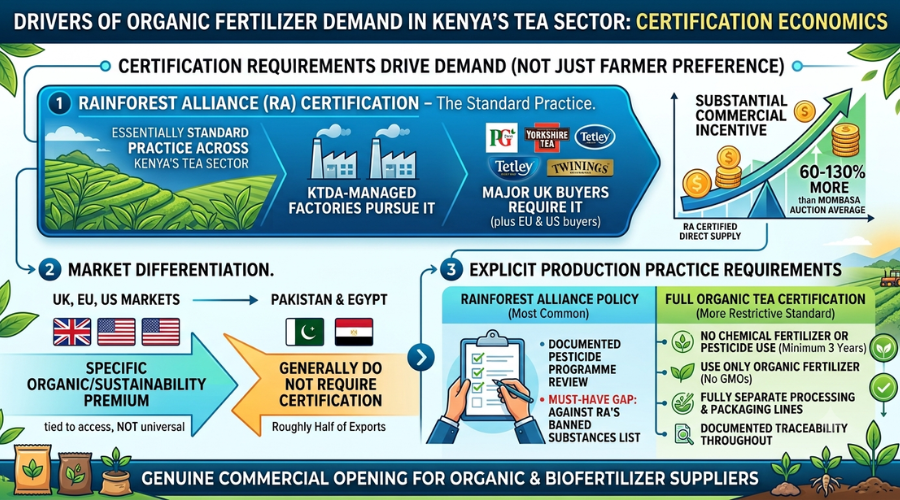
Rainforest Alliance (RA) certification has become essentially standard practice across Kenya’s major tea sector: virtually all KTDA-managed factories have pursued it, and major UK buyers including PG Tips, Yorkshire Tea, Tetley, and Twinings require it as a condition of purchase, along with many EU and US buyers. The commercial incentive is substantial — Rainforest Alliance-certified direct supply reportedly earns 60-130% more than the Mombasa auction average. Kenya’s largest tea buyers, Pakistan and Egypt, together taking roughly half of exports, generally do not require certification — meaning the organic/sustainability premium is specifically tied to accessing UK, EU, and US markets, not universal across all export volume.
What certification standards actually require of inputs
Kenya’s tea certification requirements are explicit about production practices. Kenya’s Rainforest Alliance policy mandates documented pesticide programme review against RA’s banned substances list as a priority “must-have” gap for most Kenyan farms. Separately, for full organic tea certification (a distinct, more restrictive standard than RA), farms must show no chemical fertilizer or pesticide use for at least three years, use only organic fertilizer with no GMOs, and maintain fully separate processing and packaging lines for organic product, with documented traceability throughout.
Coffee follows a similar three-year conversion requirement: Kenyan coffee farmers seeking organic certification must complete a three-year conversion period during which synthetic chemicals and banned substances are fully avoided, with vermicomposting training already underway through initiatives like the TRACE Kenya project supporting cooperatives such as Kichawir Farmers Cooperative Society. Know more…
The certification cost structure creates a genuine input-market opportunity
Organic coffee certification in Kenya costs between €1,600 and €3,000, covering application, annual inspection, and audit fees, depending on farm size and certifying agent. Locally, organic fertilizer products themselves must be registered with the Kenya Bureau of Standards (KEBS) under Kenya Standard KS 2290:2018, at a cost of KES 30,000-40,000 per product, renewable every two years. This dual-cost structure — farm-level certification plus product-level registration — means cooperatives and estates transitioning to organic inputs need suppliers who already understand KEBS registration status, not just agronomic performance.
Where the opportunity concentrates
| Segment | Certification driver | Relevance for organic/biofertilizer suppliers |
|---|---|---|
| KTDA-managed tea factories | RA certification near-universal; UK/EU buyer requirement | Large, organized cooperative structure — single decision points for input procurement at factory level |
| Premium export-oriented coffee cooperatives | Three-year organic conversion process; EU/specialty buyer demand solidaridadnetwork | Multi-year conversion window offers time to establish supply relationships and demonstrate product performance |
| Domestic/regional market tea and coffee (Pakistan, Egypt-bound) | No certification requirement | Lower near-term organic-input demand pressure; not the primary near-term target segment |
What manufacturing, blending, and distribution roles look like in this market
- Manufacturing: producing KEBS-registered organic fertilizer or biofertilizer products specifically formulated for tea and coffee soil/nutrient profiles, requiring the KS 2290:2018 registration process before commercial sale.
- Blending/formulation: adapting a base organic input to meet the specific nitrogen and micronutrient needs of tea (tea’s nitrogen demand averages around 60 kg per hectare when met through composted manure, according to organic tea/coffee market research).
- Distribution: reaching KTDA-affiliated factory management or coffee cooperative procurement committees directly, since these organized structures typically make centralized input-purchasing decisions on behalf of member farmers.
Practical entry considerations for Indian MSME suppliers
An Indian organic fertilizer or biofertilizer manufacturer entering this segment should recognize that Kenyan tea and coffee buyers are not evaluating products in isolation — they are evaluating whether a supplier’s product can help farms pass a specific, documented certification audit. This means technical collaboration should focus on product-registration support (navigating KEBS/KEPHIS processes), documented compliance with certification-relevant standards (e.g., absence of banned substances), and formulation calibrated to the specific nitrogen and nutrient requirements of tea and coffee rather than generic fertilizer blends.
Regulatory and feasibility caution
Certification requirements, registration costs, and market access rules change over time — Kenya’s own RA certification requirement was suspended in May 2025 and reinstated in November 2025, illustrating how quickly policy can shift. This article does not constitute regulatory, certification, or investment advice. Prospective suppliers should verify current KEBS/KEPHIS registration requirements, current certification body policies, and specific buyer requirements directly with the relevant Kenyan authorities and certification bodies before committing to product development or market entry.agrosocialservices.co
Looking to supply organic fertilizer or biofertilizer inputs to Kenya’s certified tea and coffee sector?
Gondwana Treasures helps connect Indian MSME manufacturers with Kenyan cooperatives, estates, and distributors navigating the shift toward certified organic inputs. Contact Gondwana Treasures to discuss your product category and target segment within Kenya’s tea and coffee value chain.