
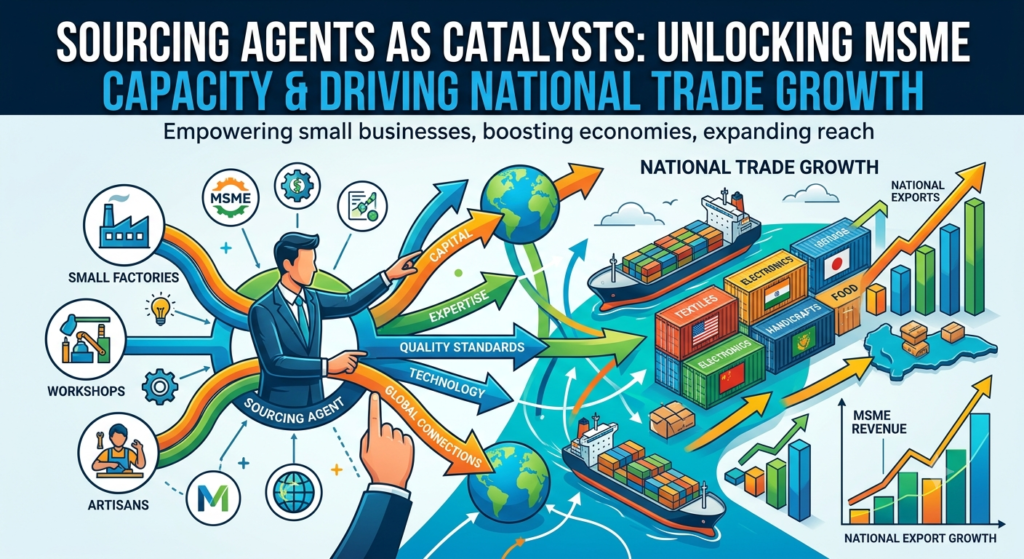
Today, Indian MSMEs contribute ~45–48% of total exports. In this evolving landscape of global trade, sourcing agent’s role in MSME growth and international trade also plays very important role. The sourcing agents have emerged as critical enablers bridging fragmented MSME ecosystems with structured international markets. Their contribution extends far beyond transactional facilitation— A sourcing agent play a strategic role in strengthening supply-side capabilities, enhancing export readiness through MSME growth and International Trade, accelerating economic development.
For MSMEs, especially in sectors like food processing, agro-commodities, and specialty ingredients, access to international markets is often constrained by gaps in compliance, scale, and market intelligence. A competent sourcing agent addresses these barriers by aligning MSME production with global demand patterns. They guide enterprises on product specifications, certifications (such as HACCP, ISO, or EU standards), and packaging norms, thereby upgrading the operational and quality benchmarks of local manufacturers.
This intervention directly contributes to capacity development. MSMEs begin to transition from unorganized suppliers to export-ready units capable of consistent quality, traceability, and scalability. Over time, this leads to better utilization of production capacity, reduced wastage, and improved margins due to access to premium international buyers.
At a macro level, sourcing agents play a pivotal role in enhancing a country’s export competitiveness. By aggregating supply from multiple MSMEs and standardizing it to meet international requirements, they create reliable export pipelines. This reduces dependency on large exporters and diversifies the export base, making the trade ecosystem more resilient.
Moreover, sourcing agents act as market intelligence hubs. They continuously track global pricing trends, demand shifts, and regulatory changes, transmitting this knowledge back to MSMEs. This feedback loop ensures that domestic production remains aligned with global opportunities, minimizing the risk of overproduction or market mismatch.
From a policy perspective, integrating sourcing agents into export promotion frameworks can significantly amplify the impact of government initiatives such as MSME development schemes and export incentives. Encouraging formalization, digital onboarding, and certification support through sourcing networks can accelerate the internationalization of small businesses.
The ripple effect on the national economy is substantial. Increased MSME exports lead to higher foreign exchange earnings, job creation in rural and semi-urban areas, and stronger value chains in agriculture and manufacturing. Additionally, it fosters innovation as MSMEs adapt to evolving global standards and consumer preferences.
In essence, sourcing agents are not merely intermediaries—they are ecosystem builders. By enabling MSMEs to compete globally, they contribute to a more inclusive, diversified, and robust economic growth model. Recognizing and strengthening this role can be a strategic lever for nations aiming to expand their footprint in international trade.
At Gondwana Treasures, every connection is built on due diligence, every supplier is carefully evaluated, and every commitment is honoured. For international buyers looking to source from Indian MSMEs with confidence, we are not just facilitators – We are your eyes, ears and trusted partners on the ground !!
To know more about our services, click here.
Please connect with us to explore a fruitful and profitable collaboration opportunity.