
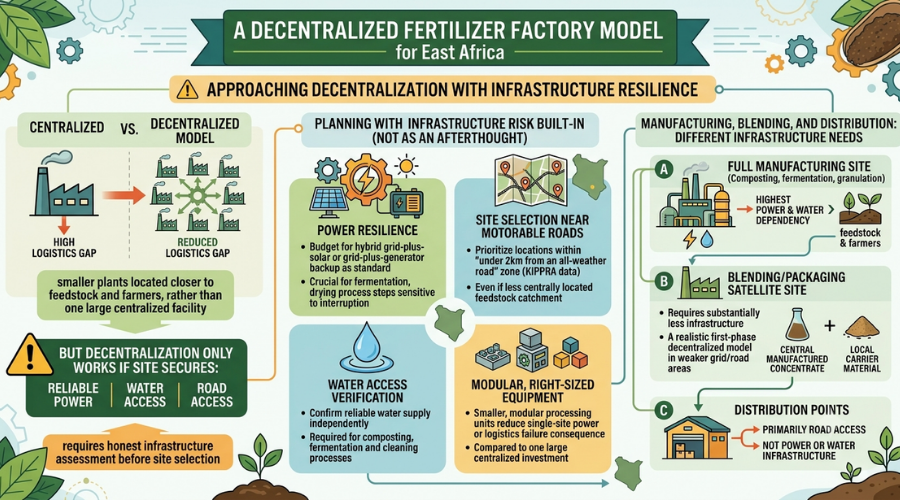
A decentralized fertilizer factory model — smaller plants located closer to feedstock and farmers, rather than one large centralized facility — is often proposed as the solution to East Africa’s logistics gap. But decentralization only works if each site can actually secure reliable power, water and road access, and this requires honest infrastructure assessment before site selection.
The centralization vs. decentralization trade-off
A single large plant benefits from economies of scale but concentrates transport costs onto outbound distribution to farmers spread across a wide radius. A decentralized network of smaller plants reduces that outbound distance but multiplies the number of sites needing independent power, water and road access — each with its own infrastructure risk profile.
Electricity access: a genuine sizing constraint
Kenya has made real national progress, with electricity access rising from approximately 30% in 2014 to over 75% by 2024 (65% grid-connected, 0.84% mini-grid, 9.2% standalone solar), according to Kenya’s Ministry of Energy 2025 National Energy Compact. However, this national figure masks a sharp rural-urban divide. Source : Kenya National Energy Compact 2025-2030
An Afrobarometer survey found that while 87% of Kenyans live in zones nominally served by the national grid, only 51% of rural residents actually hold a grid connection, compared to 90% of urban residents. Even among connected households, reliability drops sharply outside cities: only 35% of rural residents enjoy a reliable electricity supply, compared to 72% of urban residents. Separate academic research recorded rural blackouts in Kenya lasting up to a full year on some transformers, with an average outage duration of four months where long-term failures occurred.
Practical implication: any decentralized plant sited in a rural feedstock zone must independently verify actual grid reliability at that specific location — not rely on national or even county-level averages — before finalizing equipment and power-backup specifications.
Road access: the “first mile” bottleneck
Kenya’s road network shows a similar pattern to its power grid: broad national coverage on paper, but poor rural penetration. Only about 16% of Kenya’s rural roads are paved, and 55% of the rural population lives more than 2 kilometers from an all-weather road, according to KIPPRA (Kenya Institute for Public Policy Research and Analysis). This constraint is not unique to Kenya — close to 60% of Sub-Saharan Africa’s rural population lives more than 2 kilometers from an all-season road, per World Bank data.
Research on rural transport in Kenya and Tanzania identifies this “first mile” — the initial movement of goods from farm or feedstock source to the nearest motorable road — as the most expensive and constrained segment of the entire supply chain, with head-loading costing up to 30 times more per tonne-kilometer than truck transport.
| Infrastructure factor | Key data point | Source |
|---|---|---|
| Rural electricity connection rate (Kenya) | 51% of rural residents connected, vs. 90% urban | Afrobarometer, 2024 |
| Rural electricity reliability (Kenya) | 35% reliable supply in rural areas, vs. 72% urban | Afrobarometer, 2024 |
| Rural road paving (Kenya) | Only ~16% of rural roads paved | KIPPRA repository. |
| Rural population near all-weather road (Kenya) | 45% live within 2km; 55% do not | KIPPRA repository. |
| Sub-Saharan Africa rural road access | ~60% of rural population lives more than 2km from all-season road | World Bank documents |
Designing around these constraints
A decentralized fertilizer factory in this environment should be planned with infrastructure risk explicitly built into the design, not treated as an afterthought:
- Power resilience: budget for hybrid grid-plus-solar or grid-plus-generator backup as standard, not optional, especially for any process step (fermentation, drying) sensitive to power interruption.
- Site selection near motorable roads: prioritize locations within the “under 2km from an all-weather road” zone identified by KIPPRA data, even if this means a less centrally located feedstock catchment
- Water access verification: confirm reliable water supply independently, since composting, fermentation and cleaning processes require consistent water availability.
- Modular, right-sized equipment: smaller, modular processing units reduce the consequence of a single-site power or logistics failure compared to one large centralized investment.
Manufacturing, blending, and distribution: different infrastructure needs
A full manufacturing site (composting, fermentation, granulation) has the highest power and water dependency. A blending/packaging satellite site — combining a centrally manufactured concentrate with local carrier material — requires substantially less infrastructure and may be a more realistic first-phase decentralized model in areas with weaker grid and road access. Distribution points require primarily road access, not power or water infrastructure.
Regulatory and feasibility caution
Electricity access, reliability and road conditions vary significantly by exact site, county and season, and the aggregate figures cited here should not be treated as representative of any specific location. This article does not constitute engineering, infrastructure, or investment advice. Prospective investors should commission an independent, site-specific infrastructure assessment — including verified grid connection status, backup power requirements, and road accessibility — before finalizing any decentralized manufacturing plan.
Evaluating site locations for a decentralized fertilizer or biofertilizer factory network in East Africa?
Gondwana Treasures helps connect African investors with Indian MSME technical partners experienced in right-sizing plant design for infrastructure-constrained environments — including modular equipment options and phased manufacturing/blending models. Contact Gondwana Treasures to discuss your proposed site locations, infrastructure conditions, and technical collaboration needs.