
A verbal understanding of “we’ll help when needed” is not a substitute for a documented operational SLA in a cross-border technical partnership — especially when the technical partner is thousands of kilometers away and time zones, customs, and spare-parts logistics all add friction to any support request.
Why manufacturing SLAs differ from IT SLAs
Most publicly available Service Legal Agreement (SLA) guidance is written for IT services, but the underlying structure — service scope, measurable performance targets, response and resolution timeframes, escalation procedures, and reporting — applies directly to a technical collaboration around biofertilizer or organic fertilizer manufacturing. The key difference is that manufacturing SLAs must also account for physical constraints: shipping spare parts, scheduling on-site visits, and coordinating around production shutdown windows.
Core components every cross-border technical SLA should define
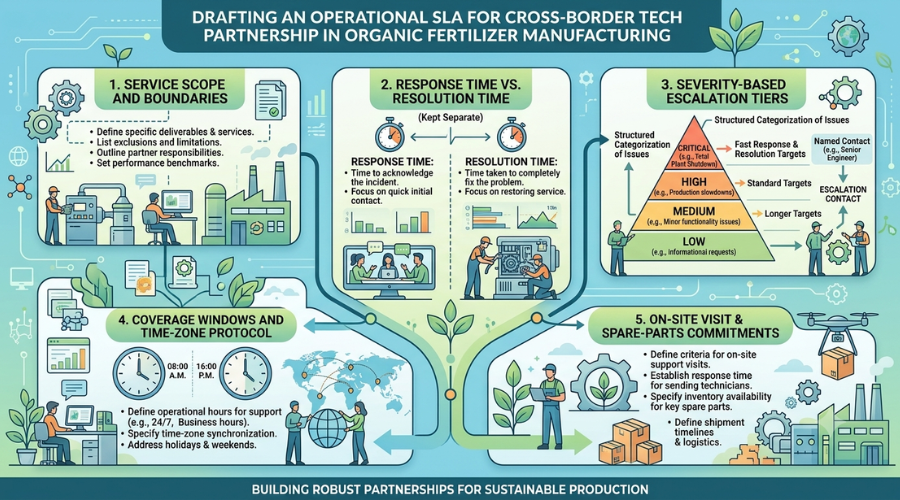
1. Service scope and boundaries
Clearly state what is included — commissioning support, formulation troubleshooting, quality-control system setup, staff training — and what is explicitly excluded, such as civil works defects or third-party equipment failures. Ambiguity here is the single most common source of later disputes.
2. Response time vs. resolution time — kept separate
These are frequently confused but must be defined independently: response time is how quickly the technical partner acknowledges an issue, while resolution time is how long it takes to actually fix it. A cross-border SLA should specify both, because acknowledgment can often be immediate (a phone call or message) while physical resolution may reasonably take days if parts or personnel must travel.
3. Severity-based escalation tiers
A structured SLA typically categorizes issues by severity, each with its own response and resolution targets and named escalation contact:
| Priority | Example issue | Typical response target | Typical resolution target |
|---|---|---|---|
| Critical (P1) | Production line stopped; contamination risk | Within hours (defined explicitly) | Fastest possible; may require remote diagnosis plus scheduled on-site visit |
| High (P2) | Reduced output; quality-control deviation | Within 1 business day | Within a mutually agreed number of days |
| Medium (P3) | Non-urgent equipment adjustment | Within 2-3 business days | Best-effort, scheduled |
| Low (P4) | General technical query, training request | Within 5 business days | Scheduled as part of routine support |
Adapted from standard severity-tiered SLA frameworks used across service industries. Click to know more…..
4. Coverage windows and time-zone protocol
Given the roughly 2.5-hour time difference between India and East Africa, the SLA should specify defined coverage hours for remote support (e.g., overlapping business hours) and separate protocols for after-hours critical issues, rather than leaving response expectations implicit.
5. On-site visit and spare-parts commitments
Because physical presence and parts shipment are unavoidable realities of manufacturing support, the SLA should specify: the maximum response time for scheduling an on-site visit when remote troubleshooting fails, a defined critical spare-parts list with estimated shipping/import lead times, and who bears travel and shipping costs under what circumstances.
6. Reporting and review cadence
Regular, scheduled performance reporting — monthly or quarterly — keeps both parties accountable and provides an evidence trail if disputes arise later. Reports should document response/resolution times actually achieved against the agreed targets.
7. Remedies for non-performance
SLAs commonly define what happens if targets are missed — service credits, penalty clauses, or a defined right to escalate to a joint review committee. For a manufacturing JV, remedies might also include an extended warranty period or additional free training sessions rather than purely financial penalties.
Manufacturing, blending, and technical-support scope should be documented separately
- Manufacturing support SLA: covers formulation troubleshooting, fermentation/composting process issues, and quality-control calibration — typically the most technically complex and time-sensitive category.
- Blending/packaging support SLA: narrower scope, generally focused on mixing consistency and packaging-line mechanical issues.
- Staff training commitments: should be documented with defined session counts, competency-verification methods, and refresher-training frequency, separate from the reactive support SLA.
What to avoid in SLA drafting
Avoid vague language like “reasonable effort” or “as soon as possible” without a defined timeframe — these are unenforceable and create disputes precisely when clarity matters most. Equally, avoid setting resolution targets that ignore physical shipping and customs realities; an SLA promising “resolution within 24 hours” for a part that takes weeks to import sets both parties up for guaranteed breach.
Regulatory and feasibility caution
SLA terms, remedies, and enforceability depend on the governing law specified in the underlying contract and vary by jurisdiction; the frameworks described here are general industry practice, not a template applicable without legal review. This article does not constitute legal advice. Any operational SLA for a cross-border manufacturing partnership should be drafted or reviewed by qualified legal counsel familiar with both Indian and the relevant East African jurisdiction’s contract law.
Structuring an operational SLA for your Indian technical partnership in organic fertilizer or biofertilizer manufacturing?
Gondwana Treasures helps facilitate initial B2B coordination between African investors and Indian MSME technical partners — supporting scoping discussions that inform clear, enforceable service-level agreements. Contact Gondwana Treasures to discuss your project’s technical support and SLA requirements.