
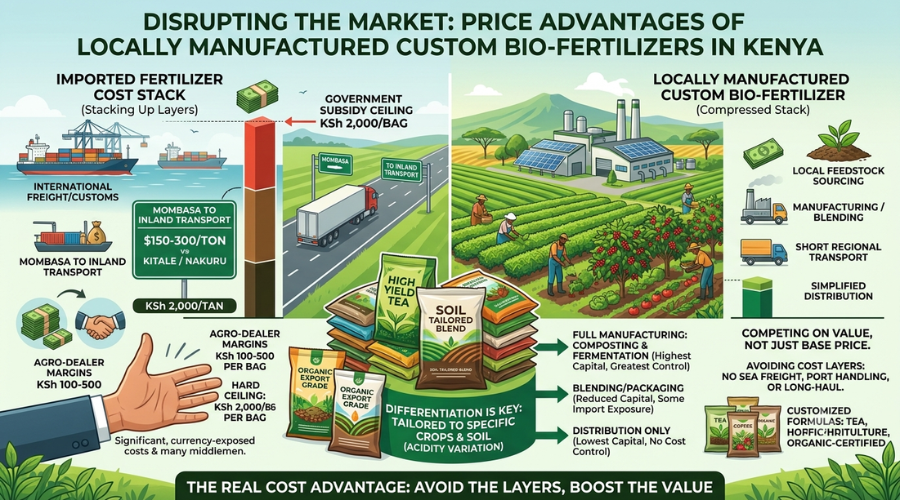
Any conversation about the locally manufactured bio-fertilizer price in Kenya has to start with an honest baseline: Kenya’s government-subsidized conventional fertilizer is now priced at KSh 2,000 per 50kg bag as of September 2026, a price point that sets a real ceiling any new entrant must understand before assuming automatic price competitiveness.
Kenya’s price environment has shifted sharply — know the current baseline
Kenya’s National Fertilizer Subsidy Programme has driven remarkable price reductions: a 50kg bag that retailed at roughly KSh 7,500 in 2022 dropped to KSh 2,500, and was cut further to KSh 2,000 effective September 1, 2026, according to Agriculture Cabinet Secretary Mutahi Kagwe. By comparison, unsubsidized commercial fertilizer can still cost as much as KSh 7,000 at retail shops. Current market-tracked prices for unsubsidized DAP average around KSh 3,975 per 50kg bag nationally, and NPK averages around KSh 3,388-3,406, though prices vary meaningfully by county and market. Know more…
What this means for a new manufacturer: subsidized conventional fertilizer is not a price target you can realistically undercut directly. Any locally manufactured organic or biofertilizer product competes on a different value proposition — soil health, certification compliance, or specialty crop suitability — not on being simply “cheaper than subsidized NPK.”
Where local manufacturing genuinely gains a price edge
The real cost advantage of local manufacturing isn’t beating the subsidy price — it’s avoiding the cost layers that stack onto imported fertilizer before it reaches a Kenyan farmer. Kenya’s Competition Authority found that transport costs alone from Mombasa to inland markets range from $150-180/ton for Nairobi-bound cargo to $283-300/ton for Kitale, a major agricultural region further inland. Agro-dealer margins add a further KSh 200-400 per 50kg bag in Nairobi and KSh 100-500 in Nakuru on top of the base import price.
A locally manufactured product, by contrast, can compress this cost stack by eliminating international freight, port handling, and long-haul inland transport — provided the manufacturing site itself is reasonably close to its target distribution zone.
Price comparison: cost layers that matter
| Cost layer | Imported fertilizer | Locally manufactured product |
|---|---|---|
| International freight/customs | Significant, currency-exposed | Not applicable |
| Mombasa-to-inland transport | $150-300/ton depending on destination | Reduced if plant is sited near target market |
| Agro-dealer margin | KSh 100-500 per 50kg bag | Same margin structure applies, but on a lower base cost |
| Subsidy competition | Government-subsidized conventional fertilizer at KSh 2,000/bag sets a hard price ceiling | Cannot compete on price alone against subsidized product; must compete on differentiation |
What “custom” bio-fertilizer actually means for pricing strategy
A generic organic fertilizer competing purely on price against KSh 2,000 subsidized NPK is a difficult position. A customized bio-fertilizer — formulated for a specific crop (tea, coffee, horticulture), soil condition (see county-level acidity variation), or certification requirement (organic-certified, RA-compliant) — competes on value rather than price alone, since certified export-oriented farmers already accept the KSh 1,600-3,000 cost of organic certification itself as a business investment tied to premium market access.
Manufacturing, blending, and distribution cost structures differ
- Full manufacturing (composting, fermentation from raw feedstock) carries the highest capital cost but the greatest control over final product cost and formulation.
- Blending/packaging (combining an imported concentrate with local carrier material) reduces capital requirements and can reach market faster, though it retains some import-cost exposure on the concentrate component.
- Distribution-only models carry the lowest capital requirement but no ability to influence the underlying product cost structure at all.
Regulatory and feasibility caution
Fertilizer subsidy pricing, market rates, and transport costs change frequently and are subject to government policy shifts, as demonstrated by the multiple price reductions Kenya has implemented since 2022. This article does not constitute investment, pricing, or regulatory advice. Prospective manufacturers should verify current subsidy program terms, KEBS product registration costs, and site-specific transport economics through an independent feasibility study before finalizing any pricing or market-entry strategy.
Exploring whether a locally manufactured bio-fertilizer product can compete effectively in Kenya’s current price environment?
Gondwana Treasures helps connect African investors with Indian MSME technical partners experienced in formulation, cost-structure planning, and market positioning for organic and biofertilizer products. Contact Gondwana Treasures to discuss your target crop segment, pricing strategy, and technical collaboration needs.