
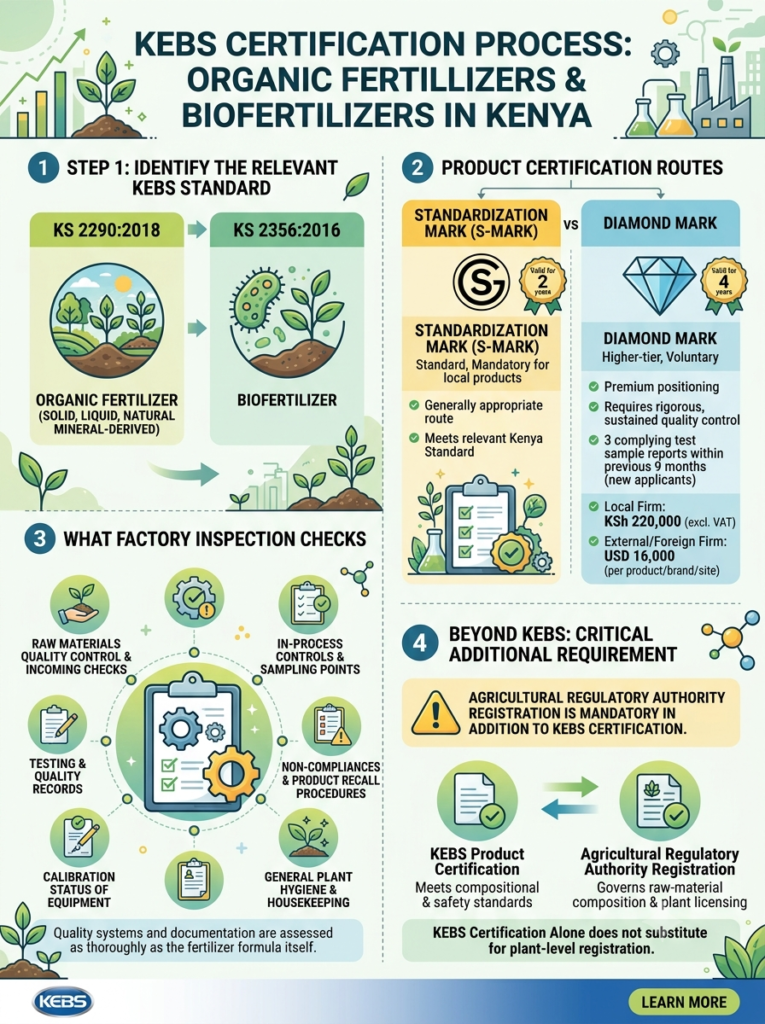
KEBS certification for organic and biofertilizers manufactured in Kenya is a legal requirement, not an optional quality badge — no locally made organic fertilizer or biofertilizer can be lawfully sold in Kenya without it.
Which standard applies to your product
The Kenya Bureau of Standards (KEBS) maintains two distinct standards covering this product category, and identifying the correct one is the first step in any application:
| Standard | Covers | Key compositional requirements |
|---|---|---|
| KS 2290:2018 | Organic fertilizer (solid, liquid, and natural mineral-derived) | pH 5.5–8.5; carbon-to-nitrogen ratio ≤ 20:1; nitrogen content > 1%; organic matter content ≥ 70%; total primary nutrients (NPK) ≥ 3.5% by weight |
| KS 2356:2016 | Biofertilizer | Separate microbial-based standard distinct from organic fertilizer requirements |
A manufacturer producing a carrier-based microbial inoculant should apply under KS 2356:2016, while a composted or manure-derived organic fertilizer falls under KS 2290:2018 — these are not interchangeable, and applying under the wrong standard will delay certification.
Two certification mark options — and they are not the same
KEBS offers two distinct product certification routes, each with different validity periods, fees, and rigor:
Standardization Mark (S-Mark)
This is the standard, mandatory certification mark for locally manufactured products meeting the relevant Kenya Standard, and it is generally the appropriate route for organic fertilizer and biofertilizer manufacturers. The permit is valid for two years from the date of issue.
Diamond Mark
This is a higher-tier, voluntary certification requiring three complying test sample reports within the previous nine months (for new applicants) and demonstrating a more rigorous, sustained quality-control track record. It carries a four-year validity period, but at substantially higher cost — KSh 220,000 (excluding VAT) for a local firm, or USD 16,000 for an external/foreign firm, per product/brand/production site. This route is generally more relevant for established manufacturers seeking premium market positioning rather than a first-time applicant.
The step-by-step S-Mark application process
- Register on the KIMS portal at kims.kebs.org and create a manufacturer
- Submit the application including the Standardization Mark Application Form (STA 1), initial factory assessment form (STA 10 for new applicants), and the standards levy notification form (SL1)
- Provide supporting documents: company registration certificate (CR12 for limited companies, or equivalent for cooperatives/self-help groups), KRA PIN, product formulation details, and label artwork
- Pay the application fee — a non-refundable fee (reported around KSh 5,800 per product in some sector examples, though fees vary by product category)
- Factory inspection — KEBS quality assurance officers visit the production facility to carry out an industrial inspection, evaluate process controls, and draw samples for laboratory analysis
- Sample testing — samples are tested at KEBS or accredited laboratories against the applicable Kenya Standard (KS 2290:2018 or KS 2356:2016)
- Permit issuance — if samples comply and the inspection report confirms adherence to codes of practice, the Permit Standardization Committee (PSC) issues the permit, and the manufacturer displays the standardization mark logo with a unique permit number on product labeling.
If samples fail testing initially, retesting is done free of charge once; a second failure shifts subsequent testing costs to the manufacturer. Know more…
What the factory inspection actually checks
KEBS inspectors evaluate far more than the finished product. Inspection criteria include quality checks and sampling points across the production system, evidence of quality control on incoming raw materials and in-process controls, testing and quality records, handling of non-compliances and product recalls, product labeling accuracy, calibration status of equipment, and general plant hygiene and housekeeping. This means a manufacturer’s quality-control systems and documentation practices are assessed as thoroughly as the fertilizer formula itself.
Beyond KEBS: registration is not the only requirement
KEBS product certification confirms the product meets compositional and safety standards, but fertilizer manufacturing in Kenya also requires separate registration with the relevant agricultural regulatory authority governing raw-material composition and manufacturing-plant licensing — a distinct process from KEBS product certification. Manufacturers should confirm both requirements are satisfied, as KEBS certification alone does not substitute for plant-level agricultural registration.
Manufacturing, blending, and packaging: certification implications differ
A full manufacturer producing organic fertilizer or biofertilizer from raw feedstock must certify under the applicable standard and undergo full factory inspection. A blender/formulator combining KEBS-certified base products with additives may need to certify the final blended product separately if it constitutes a distinct commercial product. A pure distributor reselling an already KEBS-certified product generally does not require separate product certification but should verify the supplying manufacturer’s permit is current and valid.
Regulatory and feasibility caution
KEBS standards, fees, and application procedures are subject to periodic revision; the figures and steps cited here reflect published KEBS guidance and third-party summaries as of this writing and should be independently verified directly with KEBS before beginning an application. This article does not constitute regulatory or legal advice. Prospective manufacturers should confirm current standard versions, fee schedules, and any additional agricultural-authority registration requirements directly with KEBS and Kenya’s relevant fertilizer regulatory body before committing capital to production.
Preparing to manufacture and certify an organic fertilizer or biofertilizer product in Kenya?
Gondwana Treasures helps connect African investors with Indian MSME technical partners experienced in quality-control systems and formulation practices that support KEBS certification readiness. Contact Gondwana Treasures to discuss your product category and certification preparation needs.