
Building a genuinely bankable ESG fertilizer project in Africa requires structuring the venture around specific, documented criteria long before you approach a green fund — because development finance institutions decline unprepared proposals before a term sheet is ever issued.
Green capital exists for this sector — but requires proof, not intent
The Green Climate Fund (GCF) maintains a structural bias toward African projects, targeting a 50:50 balance between mitigation and adaptation investments while reserving a floor of 50% of its adaptation allocation specifically for Least Developed Countries, Small Island Developing States, and African States. The African Development Bank alone allocated $5.5 billion to climate finance in 2024, and institutions including IFC, AfDB, and regional development finance institutions apply broadly consistent preparation standards across Sub-Saharan Africa, Latin America, and Southeast Asia. Know More…
However, access flows only through accredited entities — international organizations (AfDB, FAO, UNEP, UNDP, IFAD), national Direct Access Entities, or private-sector organizations working through an accredited partner. A fertilizer manufacturing venture cannot typically apply to GCF directly; it must work through one of these accredited channels or through a domestic financial intermediary carrying a development-finance on-lending mandate. Know More…
The four criteria DFIs and green funds actually evaluate
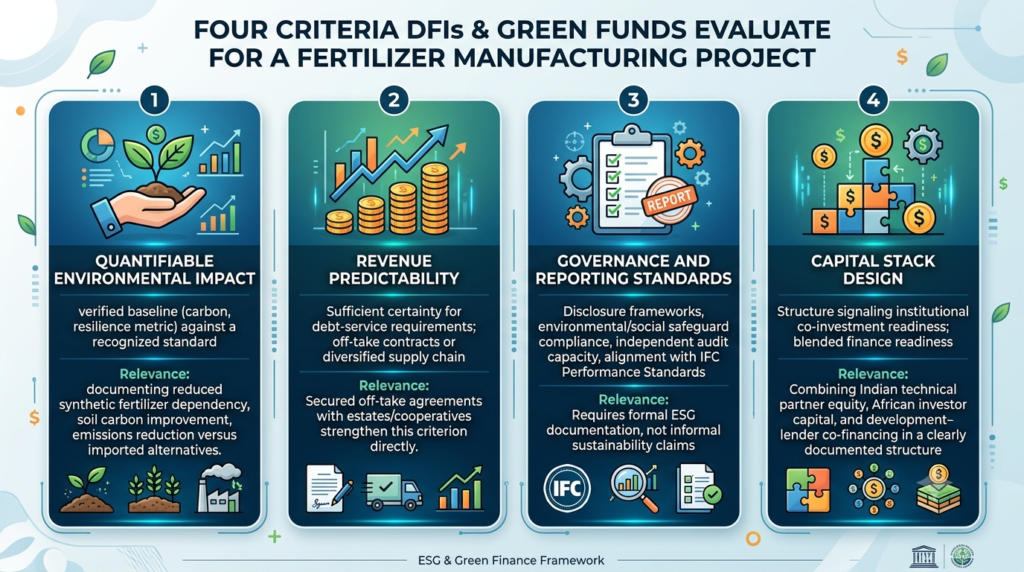
Analysis of current agri-climate financing practice identifies four conditions a project must satisfy before institutional capital becomes accessible:
| Criterion | What it requires | Relevance for a fertilizer manufacturing project |
|---|---|---|
| Quantifiable environmental impact | A verified baseline (carbon, resilience metric) against a recognized standard | Documenting reduced synthetic fertilizer dependency, soil carbon improvement, or emissions reduction versus imported alternatives |
| Revenue predictability | Sufficient certainty for debt-service requirements; off-take contracts or diversified supply chain | Secured off-take agreements with estates/cooperatives strengthen this criterion directly |
| Governance and reporting standards | Disclosure frameworks, environmental/social safeguard compliance, independent audit capacity, alignment with IFC Performance Standards | Requires formal ESG documentation, not informal sustainability claims |
| Capital stack design | Structure signaling institutional co-investment readiness; blended finance readiness | Combining Indian technical partner equity, African investor capital, and development-lender co-financing in a clearly documented structure |
IFC Performance Standards: the governance benchmark
ESG documentation aligned to IFC Performance Standards is described as a “non-negotiable requirement” for DFI review of agribusiness projects, covering environmental and social risk management systems, stakeholder engagement procedures, and monitoring/reporting frameworks. In Kenya specifically, credit applications within agribusiness of KES 5 million and above commonly go through environmental and social due-diligence assessment as standard practice among local financial institutions partnering with development funds.
Financing instruments matched to project scale
Different instruments have different minimum deal sizes and qualification thresholds, so understanding where your project fits matters before approaching any specific fund:
- Blended finance facilities: accessible from approximately US$5 million, using concessional development capital to de-risk the capital stack for commercial co-lenders
- Sustainability-linked loans: from approximately US$10 million, with interest terms adjusted based on measured environmental performance against agreed targets
- IFC direct engagement: typically from US$10 million minimum
- Labeled green bonds: generally require at least US$50 million in project scale to be economically viable for issuance, given ICMA Green Bond Principles compliance costs
- Carbon credit-linked structures: revenue-linked, requiring accredited carbon verification (Verra VCS or Gold Standard)
For most first-phase Indo-African biofertilizer or organic fertilizer ventures — likely below the $50 million bond threshold — blended finance facilities or direct DFI engagement are the more realistic entry points than labeled bond issuance.
Kenya-specific precedent worth understanding
The AgriFI Kenya Challenge Fund, financed by the European Union, screens agri-enterprise applicants based on projected economic viability alongside documented social and environmental impact, including demonstrated benefit to smallholder farmers. A related Equity Bank credit line under a European Investment Bank facility applies both negative screening (no adverse environmental/social impact) and normative screening (applicants must show they promote adoption of Good Agricultural Practices certification among partner farmers) — illustrating the kind of documented, farmer-level impact evidence Kenyan-focused funds specifically look for.
Manufacturing, blending, and distribution: different ESG documentation needs
A full manufacturing operation (composting, fermentation) carries the strongest environmental-impact narrative — reduced synthetic input dependency, circular waste utilization — but requires the most rigorous emissions/resilience baseline documentation. A blending/packaging operation has a narrower environmental story and may qualify more readily for smaller blended-finance instruments than for labeled green bonds. Distribution-focused ventures generally do not qualify as standalone green-fund applicants but may benefit indirectly through anchor manufacturer relationships.
Regulatory and feasibility caution
Green fund eligibility criteria, accreditation requirements, and minimum deal sizes change over time and vary by institution; the figures and frameworks cited here reflect current published guidance and should be independently verified with the specific fund or DFI before proposal development. This article does not constitute financial or investment advice. Any ESG-aligned financing strategy should be developed with qualified financial advisors experienced in development finance, alongside an independent feasibility study and environmental baseline assessment.
Structuring an Indo-African fertilizer manufacturing project for green fund or DFI financing?
Gondwana Treasures helps connect African investors with Indian MSME technical partners whose formulation and process expertise can support the environmental-impact documentation ESG-focused lenders require. Contact Gondwana Treasures to discuss your project’s scale, target financing instrument, and technical collaboration needs.