
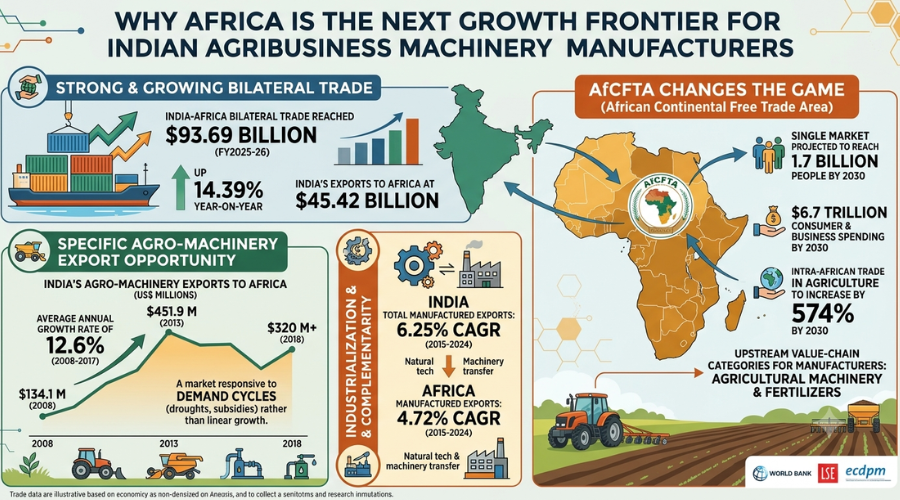
The trade data makes a clear case: Africa is emerging as a genuine growth frontier for Indian agribusiness machinery manufacturers, backed by rising bilateral trade volumes, continental market integration, and a documented gap in local agro-processing capacity.
The trade relationship is already substantial and growing
India-Africa bilateral trade reached $93.69 billion in FY2025-26, up 14.39% year-on-year, with India’s exports to Africa at $45.42 billion. Machinery and mechanical appliances already represent a meaningful share of this trade, alongside pharmaceuticals, vehicles, and agricultural equipment. Earlier CII analysis put India-Africa trade at $103 billion in FY2025, with machinery and transport equipment among India’s top export categories to the continent. Know more…
Where the specific opportunity lies: agro-machinery exports
India’s agro-machinery exports to Africa nearly doubled over a decade, from $134.1 million in 2008 to $259.7 million in 2017, registering an average annual growth rate of 12.6%, according to EXIM Bank of India research. This trajectory wasn’t linear — exports peaked at $451.9 million in 2013 before declining, then recovered to cross $320 million by 2018. This pattern suggests a market that responds strongly to specific demand cycles (drought years, subsidy program shifts) rather than one with guaranteed, steady growth — a nuance investors should weigh rather than ignore.
More broadly, India’s total exports of manufactured products grew at a 6.25% CAGR between 2015 and 2024, while Africa’s own manufactured exports grew at 4.72% CAGR over the same period — indicating both economies are industrializing, creating natural complementarity for technology and machinery transfer.
AfCFTA changes the addressable market calculation
The African Continental Free Trade Area (AfCFTA) fundamentally changes what “the African market” means for a machinery exporter. Rather than 54 fragmented national markets, AfCFTA creates a single market projected to reach 1.7 billion people and $6.7 trillion in consumer and business spending by 2030. Intra-African trade in agriculture is projected to increase by 574% by 2030 if tariffs are eliminated under AfCFTA, and agriculture and agro-processing was specifically identified as one of four priority sectors in AfCFTA’s Private-Sector Engagement Strategy.
Critically for machinery and fertilizer exporters specifically, multiple independent analyses — from the World Bank, LSE, and ECDPM — converge on the same finding: intra-African trade in manufacturing stands to benefit most from AfCFTA, and agricultural machinery and fertilizers are explicitly identified as upstream value-chain categories with sizeable trade-creation opportunities.
What this means in practical terms
| Trend | Data point | Implication for Indian MSME machinery suppliers |
|---|---|---|
| Bilateral trade growth | $93.69 billion FY2025-26, up 14.39% | Established, growing trade infrastructure and commercial relationships already exist |
| Historical agro-machinery export growth | 12.6% AAGR (2008-2017) | Demonstrated market absorption capacity for Indian agricultural equipment specifically |
| AfCFTA manufacturing trade boost | Intra-Africa manufacturing trade could rise 110% under full AfCFTA implementation | A plant built in one African country gains improved access to neighboring markets under regional trade rules |
| Job creation potential | AfCFTA could create 16 million manufacturing jobs continent-wide, per Brookings Institution estimates assets. | Signals strong political and institutional support for local manufacturing investment across the continent |
Why this matters more for East Africa specifically
The EAC has offered favorable tariff treatment on select agricultural products under regional trade frameworks, and Kenya, Tanzania, and Uganda together represent an integrated regional market that already trades fertilizer and agricultural inputs across borders (Kenya’s existing fertilizer exports to Burundi being one documented example). This existing regional trade infrastructure means an Indian machinery or technology partner entering East Africa isn’t just accessing one country’s market — it’s positioning within a trade corridor with room to expand as AfCFTA implementation deepens.
Manufacturing, blending, and distribution: different entry strategies
Manufacturing equipment suppliers benefit most directly from AfCFTA’s projected manufacturing trade growth, since locally assembled or licensed machinery gains regional market access advantages. Blending/formulation technology providers can enter with lower capital commitment while building market presence ahead of full-scale manufacturing investment. Distribution partners benefit from the broader trade volume growth without needing to navigate manufacturing-specific regulatory or capital requirements.
Regulatory and feasibility caution
Trade statistics, AfCFTA implementation timelines, and projected growth figures are subject to revision, and historical export patterns (such as the 2013-2016 agro-machinery export decline) demonstrate that growth is not guaranteed or linear. This article does not constitute investment or market-entry advice. Prospective Indian MSME manufacturers should commission an independent, country-specific market assessment and verify current AfCFTA implementation status and tariff schedules before committing to any Africa market-entry strategy.
Exploring Africa as your next export or manufacturing partnership market?
Gondwana Treasures helps Indian MSME machinery and technology manufacturers connect with African investors, distributors, and joint-venture partners across Kenya, Tanzania, Uganda, and the wider East African region. Contact Gondwana Treasures to discuss your product category and target market entry strategy.