
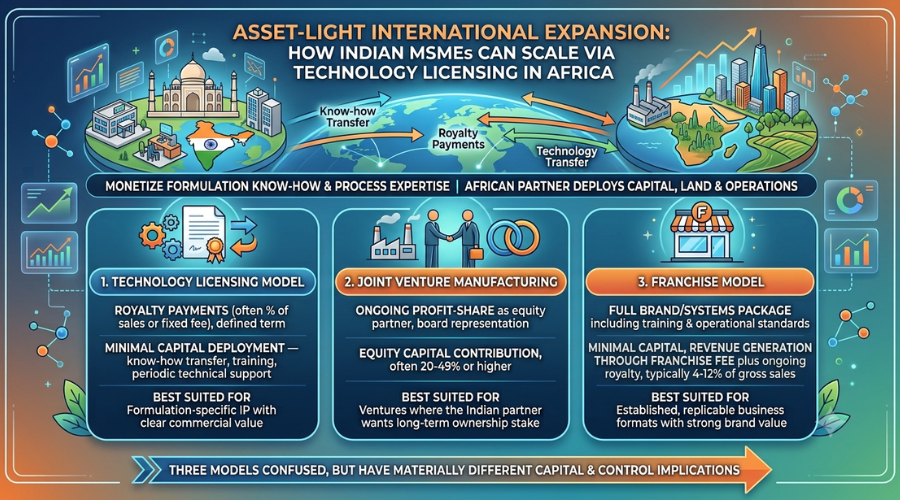
Not every Indian MSME needs to build a factory in Kenya to earn revenue there — asset-light expansion through technology licensing allows a manufacturer to monetize its formulation know-how and process expertise while an African partner deploys the capital, land, and local operations.
What “asset-light” actually means in this context
The Boston Consulting Group identifies licensing as one of nine recognized asset-light business models, distinguishing “licensing out” — where a company licenses its product, process, or brand to a partner in another market — from “licensing in,” “franchising,” and outsourcing arrangements. For an Indian organic fertilizer or biofertilizer MSME, licensing out means transferring formulation know-how, production processes, and quality-control systems to a Kenyan partner in exchange for royalty payments, without the Indian company deploying its own capital into land, machinery ownership, or working capital in Kenya. Know more…
Licensing vs. joint venture vs. franchising: know the distinction
These three models are often confused but carry materially different capital and control implications:
| Model | Capital deployed by Indian MSME | Ongoing relationship | Best suited for |
|---|---|---|---|
| Technology licensing | Minimal — know-how transfer, training, periodic technical support | Royalty payments (often % of sales or fixed fee), defined term | Formulation-specific IP with clear commercial value to license out |
| Joint venture manufacturing | Equity capital contribution, often 20-49% or higher | Ongoing profit-share as equity partner, board representation | Ventures where the Indian partner wants long-term ownership stake |
| Franchise model | Minimal — franchise fee plus ongoing royalty, typically 4-12% of gross sales | Full brand/systems package including training and operational standards | Established, replicable business formats with strong brand value |
Franchising in international trade specifically grants an entire proven business model — brand identity, operational processes, training, and quality standards — rather than IP alone, and generates royalty income typically in the 4-12% of gross sales range.
The tax mechanics matter — and they’re more favorable than many assume
A critical, often overlooked advantage of the licensing route is the India-Kenya Double Taxation Avoidance Agreement (DTAA), revised in 2016 and notified in 2018, which significantly reduced withholding tax on cross-border technology payments. Royalty withholding tax dropped from 20% to 10%, and fees for technical services dropped from 17.5% to 10%. This 10% treaty rate applies consistently across dividends, interest, royalties, and technical service fees under the current framework.
Under Indian domestic law, royalty payments from a Kenyan licensee to an Indian technology licensor are taxable in India if the technology is used or utilized in India-connected agreements, with the DTAA rate applying when more beneficial than the domestic Income Tax Act rate. Since the treaty rate (10%) is generally more favorable than certain domestic rates, Indian MSMEs licensing technology to Kenyan partners can benefit from this reduced withholding structure — though the specific tax treatment depends on how the agreement itself defines the payments (royalty vs. fees for technical services vs. business income).
What a technology licensing agreement should define
- Scope of licensed know-how: exact formulations, processes, and machinery specifications covered, distinguishing this from any trademark or brand licensing component
- Royalty structure: fixed fee, percentage of sales, or hybrid — and the currency and payment frequency
- Technical support obligations: what ongoing commissioning support, staff training, and troubleshooting the Indian licensor commits to, and for how long
- Quality-control standards: minimum production standards the Kenyan licensee must maintain to continue using the licensed technology
- Territory and exclusivity: whether the license covers Kenya alone, or extends to Tanzania and Uganda, and whether it is exclusive
- Term and renewal conditions: initial license period and conditions for renewal or termination
Why this model suits certain Indian MSMEs better than direct investment
A licensing-first approach lets an Indian MSME test the East African market’s demand for its specific formulation or process technology without committing capital to land acquisition, plant construction, or working capital financing in a foreign jurisdiction. If the licensing relationship performs well, it can later evolve into a deeper joint-venture equity partnership — a natural progression path rather than an irreversible upfront commitment.
Manufacturing, blending, and distribution: licensing suits some more than others
Full manufacturing technology (composting/fermentation process know-how) is well suited to licensing, since the core value is intellectual — the formulation and process — rather than physical assets. Blending/packaging technology licensing works similarly, often bundled with machinery guidance. Pure distribution rights are typically documented as distribution agreements rather than technology licenses, since no proprietary know-how transfer is involved.
Regulatory and feasibility caution
Tax treatment of royalty and technical-service payments depends on the specific structure of each agreement and is subject to interpretation by tax authorities in both India and Kenya; DTAA rates and domestic tax rules are also subject to change. This article does not constitute tax, legal, or investment advice. Any technology licensing agreement should be structured and reviewed by qualified tax and legal advisors in both India and Kenya before signing, with particular attention to how payments will be characterized (royalty, fees for technical services, or business income) for tax purposes.
Considering an asset-light technology licensing model to enter Kenya or the wider East African market?
Gondwana Treasures helps Indian MSMEs identify suitable African partners and supports initial B2B coordination for technology licensing, joint ventures, and manufacturing collaboration. Contact Gondwana Treasures to discuss your technology and licensing strategy.