
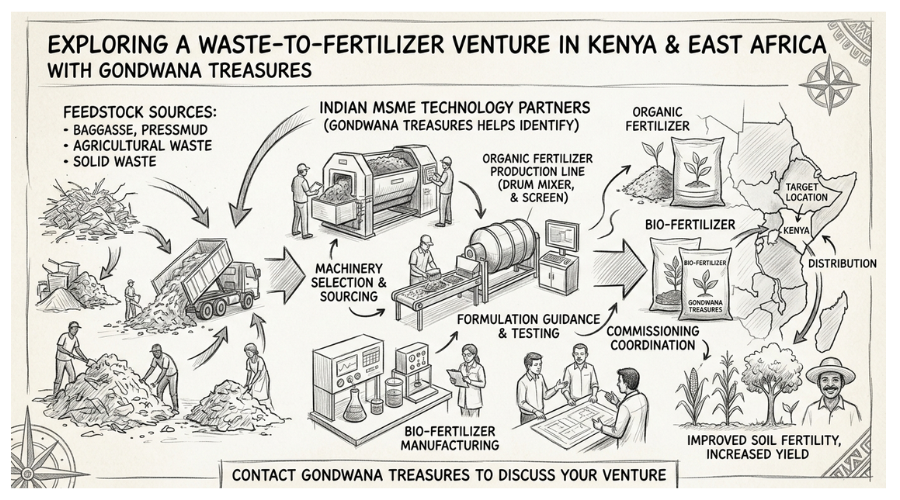
Kenya generates a large, largely unmanaged organic waste stream every year — and most of it never reaches a farm as usable fertilizer. Closing this gap requires the right agro-waste processing machinery, not just goodwill about “waste-to-value.”
The scale of Kenya’s organic waste problem
Kenya generates approximately 5.72 million tons of organic waste annually across food waste, yard waste, animal waste, agricultural waste, wood waste, and organic sludge, according to the Aspen Network of Development Entrepreneurs (ANDE, 2025). Separate estimates put total municipal solid waste generation even higher, at around 8.8 million tons per year, of which roughly 65% is organic — yet only about 18% of that organic fraction is currently composted, with the rest incinerated, dumped or landfilled. Read the source…
Nairobi alone generates an estimated 760,000 metric tonnes of waste per year, most of it wet, partly decomposed kitchen, garden, agricultural and commercial biomass — yet only about 24% is recovered for reuse. On the agricultural side specifically, a TechnoServe study for FCDO estimated approximately 1.4 million tons of organic urban and industrial waste in Kenya is economically viable to access today for fertilizer production, projected to rise to roughly 2.0 million tons by 2030.
The gap is not resource availability — it’s processing capacity.
Why this waste stays unprocessed?
Several structural barriers explain why so little of Kenya’s organic waste reaches farms as compost or bio-fertilizer:
- Collection gaps: only around 50% of Nairobi’s waste is formally collected, and uncollected waste is dumped rather than segregated.
- Limited segregation infrastructure: organic waste often arrives mixed with plastics, metals and other materials, requiring pre-processing before it can be composted.
- Low private/public processing capacity: most existing compost production in the region comes from small private operators, NGOs and community-based organizations producing only tens to low hundreds of tonnes per year — far below the millions of tonnes generated.
This is precisely the gap that appropriately scaled processing machinery, backed by technical know-how, can begin to close.
Manufacturing, blending or waste-processing — know the distinction
| Activity | What it involves | Relevant consideration |
|---|---|---|
| Waste processing/composting | Converting segregated organic waste into raw compost or organic manure | Requires feedstock segregation, moisture control, composting technology; may require environmental/waste-handling permits |
| Product manufacturing | Producing branded, quality-tested organic fertilizer or bio-enriched manure from processed compost | Requires fertilizer manufacturing registration (e.g., Kenya’s AFA) |
| Blending/enrichment | Adding microbial cultures (PSB, Rhizobium, etc.) to base compost for enhanced products | Distinct formulation and quality-control step, often requiring separate technical expertise |
| Distribution | Selling finished product to farmers, cooperatives, distributors | Requires market access, dealer network, and product registration compliance |
A serious investor should decide early which stage(s) of this chain the venture will operate in — attempting all four without phased planning increases execution risk.
Where Indian processing technology fits?
India itself generates an estimated 350 million tonnes of agricultural biomass waste annually and has, over decades, developed a wide range of mid-scale composting, fermentation, granulation and enrichment machinery suited to exactly this kind of feedstock-to-fertilizer conversion. Indian MSME machinery manufacturers offer equipment sized for a range of throughput levels — from small pilot-scale composting units to larger granulation and packing lines — allowing a Kenyan facility to match capital investment to actual, verified local feedstock volumes rather than importing an oversized or undersized system. Read the source…
Indian MSMEs can support a Kenyan agro-waste venture through:
- Composting and fermentation process design suited to Kenya’s organic waste composition
- Machinery selection: shredders, turners, screening, drying, granulation and packing equipment
- Quality-control protocols for pathogen, contaminant and nutrient testing
- Enrichment know-how for bio-fertilizer or bio-enriched organic manure formulations
- Staff training and commissioning support
What the Kenyan partner brings?
- Land and site suited to waste collection logistics (proximity to markets, slaughterhouses, or agro-processing sources — identified as major biodegradable waste generators in Kenya).
- Feedstock sourcing and collection arrangements, ideally with segregation at source
- Capital investment and working capital
- Environmental and waste-handling permits, plus fertilizer manufacturing registration where applicable
- Distribution relationships with farmer cooperatives, agro-dealers or commercial farms
Feasibility and regulatory caution
Before committing capital, prospective investors should commission an independent feasibility study addressing:
- Verified, contracted feedstock supply (not just aggregate waste-generation statistics)
- Required environmental and waste-management permits from Kenya’s National Environment Management Authority (NEMA) and county authorities
- Fertilizer product registration requirements with Kenya’s Agriculture and Food Authority (AFA)
- Realistic collection logistics costs, given that only about half of urban waste is formally collected
- Market demand and pricing for the finished compost or bio-fertilizer product
This article does not constitute investment, legal or regulatory advice. Waste collection, environmental compliance and fertilizer registration requirements should be verified directly with the relevant Kenyan authorities before project commitment.
Exploring a waste-to-fertilizer venture in Kenya or elsewhere in East Africa?
Gondwana Treasures helps identify suitable Indian MSME technology partners for composting, organic fertilizer and bio-fertilizer manufacturing — supporting machinery selection, formulation guidance, and commissioning coordination. Contact Gondwana Treasures to discuss your feedstock source, target location, and technical collaboration needs.