
A well-positioned bio-fertilizer plant in Kenya is not limited to serving Kenyan farmers alone. Kenya’s location, port access and status as an East African Community (EAC) member state gives it a structural advantage for supplying Uganda, Tanzania, Rwanda, Burundi and South Sudan — provided the regulatory and logistics groundwork is done correctly.
Why Kenya is a logical regional production base
Kenya, Ethiopia and Tanzania already dominate fertilizer demand in the eastern Africa region, with market sizes reported at approximately 789,250 metric tons, 563,362 metric tons and 246,754 metric tons respectively, according to the African Fertilizer and Agribusiness Partnership (AFAP). Kenya’s fertilizer exports within the region are already significant — mineral and chemical fertilizer is Burundi’s largest single import category from Kenya, valued at roughly $9.17 million, according to East African Community trade data.
This existing trade pattern suggests real regional demand infrastructure already exists — an advantage a new bio-fertilizer manufacturer can build on rather than create from scratch.
The regulatory picture: harmonization is underway, but not complete
Regional fertilizer trade in East Africa currently faces a mixed regulatory environment. The EAC has been developing a joint Fertilizer Policy and Bill since 2013, including a proposal for mutual recognition of fertilizers registered in any EAC partner state — a change that, once adopted, would reduce the time and cost of bringing a Kenyan-made product into Uganda or Tanzania. As of the most recent legal reviews, this EAC Fertilizer Bill remains in draft/approval stages and has not yet been formally adopted as binding regional law. Refer the Source…
In the meantime, each EAC partner state maintains its own national regime:
- Tanzania requires manufacturing, sale, and import/export of fertilizer to occur only through registered, licensed premises, with import/export permits issued by the Tanzania Fertilizer Regulatory Authority (TFRA).
- Kenya requires registration with the Agriculture and Food Authority for fertilizer manufacturing and import/export activity.
- Regional bodies such as COMESA (through ACTESA’s COMFREP programme) and the EAC continue working toward harmonized standards, but neither has yet adopted fully binding, region-wide fertilizer rules, unlike ECOWAS in West Africa, which passed a binding regulation in 2012.
Practical implication: A Kenyan bio-fertilizer producer targeting Uganda or Tanzania today should expect to pursue separate national registration in each destination country, rather than assume automatic regional recognition, until the EAC Fertilizer Bill is formally ratified and implemented.
Manufacturing vs. blending vs. distribution: know which model you’re building
| Activity | What it involves | Regulatory implication |
|---|---|---|
| Manufacturing | Producing bio-fertilizer from raw feedstock/cultures at a licensed facility | Requires manufacturing license/registration in country of production |
| Blending/formulation | Combining or reformulating already-manufactured inputs for local crop needs | May require separate registration depending on national rules |
| Cross-border distribution | Selling a Kenyan-registered product into Uganda/Tanzania | Typically requires import permit and product registration in the destination country under current national laws tfra.go |
| Technical collaboration | Indian MSME providing formulation, training, and quality-control know-how to a Kenyan-based JV | Does not itself require destination-country fertilizer registration, but the resulting product does |
What a regionally-oriented plant needs to plan for
- Multi-country product registration — budget time and cost for registering the product separately in Uganda, Tanzania, Rwanda or Burundi rather than assuming one Kenyan registration suffices.
- Quality and labeling consistency — COMESA has flagged quality assurance, packaging and labeling as priority areas partly because of counterfeit and low-quality product risks in cross-border trade.
- Logistics and customs planning — even within the EAC customs union, transport, permits and border processes affect delivered cost and timelines. Refer the source…..
- Monitoring regulatory developments — the EAC Fertilizer Bill’s mutual-recognition provision, if and when adopted, would materially simplify regional expansion; investors should track its ratification status before finalizing a multi-country distribution plan.
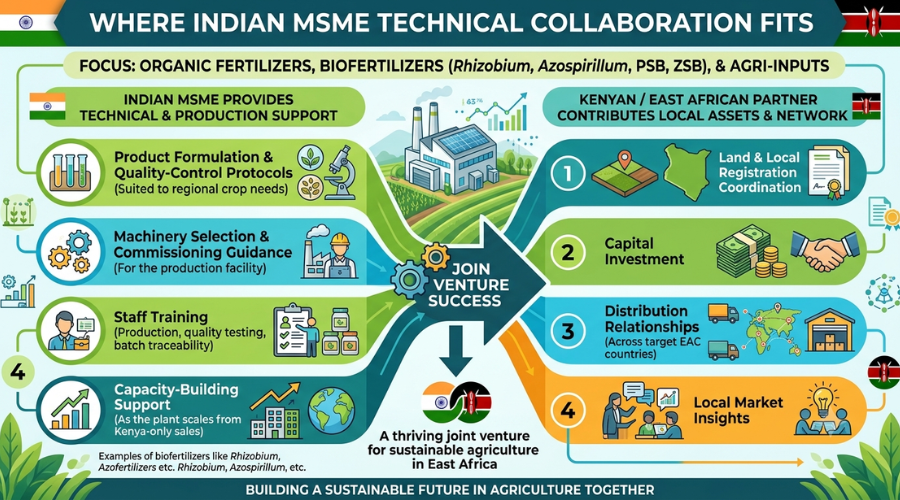
Where Indian MSME technical collaboration fits
Indian MSMEs manufacturing organic fertilizers, biofertilizers (Rhizobium, Azospirillum, PSB, ZSB) and related agri-inputs can support a Kenya-based joint venture through:
- Product formulation and quality-control protocols suited to regional crop needs
- Machinery selection and commissioning guidance for the production facility
- Staff training in production, quality testing and batch traceability
- Capacity-building support as the plant scales from Kenya-only sales toward regional distribution
The Kenyan or East African partner typically contributes land, capital, local registration coordination, and distribution relationships across the target EAC countries.
Feasibility and regulatory caution
Before committing capital to a regionally-oriented bio-fertilizer plant, investors should commission an independent feasibility study covering country-specific registration requirements, projected registration timelines and costs for each target market, updated status of the EAC Fertilizer Bill, and confirmed demand and distributor access in each intended export country. This article does not constitute regulatory, legal, or investment advice; verify all licensing requirements directly with national fertilizer regulatory authorities (e.g., Kenya’s AFA, Tanzania’s TFRA) before proceeding.
Are you exploring a Kenya-based bio-fertilizer manufacturing venture with regional export potential across Uganda, Tanzania, Rwanda or Burundi?
Gondwana Treasures helps identify suitable Indian MSME technical partners for organic fertilizer and biofertilizer manufacturing joint ventures, supporting initial coordination on formulation, plant setup and capacity building. Contact Gondwana Treasures to discuss your proposed production location, target export markets, and technical collaboration requirements.