
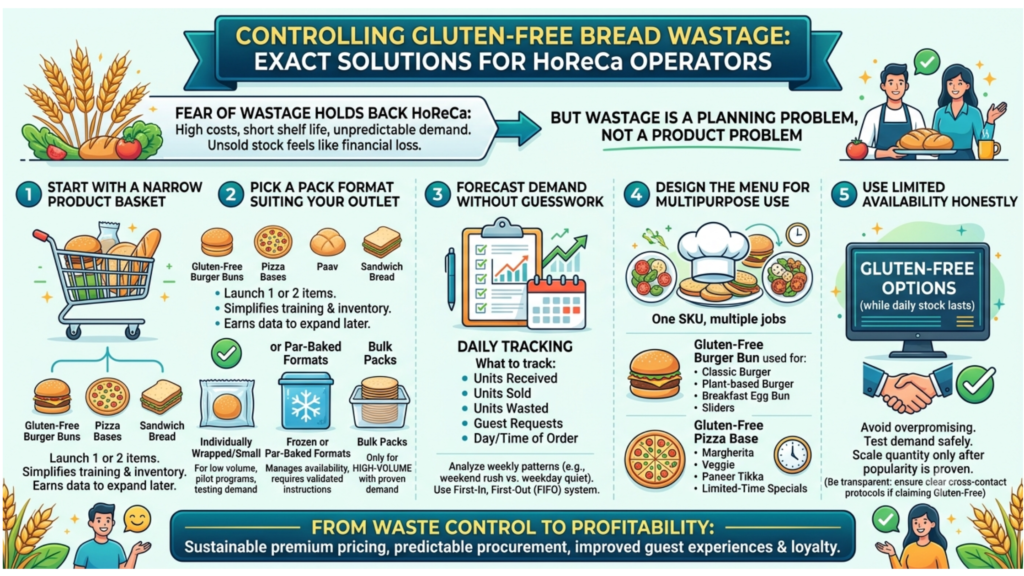
Gluten-Free Bread Wastage is the fear that stops many HoReCa operators from adding gluten-free buns, paav, wraps, sandwich breads or pizza bases to the menu. The concern is understandable. Gluten-free products may have a higher procurement cost, a shorter usable life in certain formats, and demand that appears unpredictable in the beginning. An unsold pack can feel like a small financial setback with sesame seeds on top.
But wastage is not a product problem alone. It is usually a planning problem. With the right pack formats, simple demand tracking and menu design, HoReCa operators can control Gluten-Free Bread Wastage while serving a valuable group of gluten-sensitive and health-conscious guests. The goal is not to claim “zero waste” in every outlet. The goal is to make wastage low, visible and manageable enough for gluten-free offerings to remain commercially worthwhile.
Why Gluten-Free Bread Wastage Feels Different
A regular bun often has many uses and steady demand. A gluten-free bun may initially be ordered less often, which makes managers nervous about stock sitting too long. There are also technical reasons to plan carefully. Gluten-free breads can stale differently from wheat breads, and suitable packaging, storage and handling materially affect their shelf life and quality. Research on gluten-free bakery products highlights the role of formulation and appropriate packaging in limiting staling and preserving quality. Click here to access the resource material.
For a café, QSR or restaurant, the answer is not to buy a large quantity and hope for the best. The answer is to match product format and purchase quantity to actual outlet demand.
Start with a Narrow Product Basket
The quickest way to create Gluten-Free Bread Wastage is to launch five unfamiliar products in one outlet.
Start with one or two items that fit easily into your existing menu:
- Gluten-free burger buns for signature burgers and sliders
- Gluten-free pizza bases for your most popular pizza toppings
- Gluten-free paav for paav bhaji or vada paav formats
- Gluten-free sandwich bread for café and corporate-lunch menus
A limited range makes staff training easier, reduces inventory confusion and allows you to identify which product truly has demand. Once sales patterns become clear, you can add more products with confidence.
Pick a Pack Format That Suits Your Outlet
There is no single “best” pack format. The right choice depends on outlet footfall, storage capacity, delivery frequency and menu use.
Individually Wrapped or Small Packs
For low-volume outlets, individually wrapped or small-count packs can be useful. They let staff use only what is needed while the remaining units stay sealed and clearly identified. Some gluten-free bakery suppliers offer one-, two- and four-piece packaging formats, alongside formats suitable for frozen distribution. This kind of format can be especially practical for a pilot programme or a café testing demand.
Frozen or Par-Baked Formats
Frozen or par-baked products can help outlets manage availability while reducing pressure to sell every unit immediately. However, operators should confirm the manufacturer’s storage instructions, shelf life after thawing, and reheating method before buying. Do not assume all gluten-free products can be frozen, thawed or re-frozen in the same way. Follow the supplier’s validated instructions and maintain cold-chain discipline.
Bulk Packs for High-Volume Outlets
Bulk packs are appropriate only after demand is proven. A busy QSR outlet that sells gluten-free burgers daily may benefit from better per-unit buying economics. A new pilot outlet probably will not. Start small. Let data earn the right to buy bigger packs.
Forecast Demand Without Guesswork
Gluten-Free Bread Wastage falls when purchasing is based on records rather than instinct. For the first 30 days, track five simple numbers every day:
| What to track | Why it matters |
|---|---|
| Units received | Shows what entered stock |
| Units sold | Shows real demand |
| Units wasted or expired | Identifies loss |
| Guest requests | Captures demand even when stock is unavailable |
| Day and time of order | Helps forecast high-demand periods |
After four weeks, patterns begin to appear. You may find that gluten-free burger buns sell mostly on weekends, pizza bases move during evening orders, or sandwich bread performs better in office areas during weekdays.
Order according to those patterns. Do not use a weekend’s demand to forecast a quiet Tuesday. Food-waste guidance recommends clear inventory checks, more frequent purchasing where feasible, and a first-in, first-out system so older stock is used before newer stock. These are simple habits, but they protect margins.
Design the Menu So Each Product Has More Than One Job
A gluten-free product should not be trapped inside a single menu item. For example, the same gluten-free burger bun can be used for:
- A classic burger
- A paneer or plant-based burger
- A breakfast egg bun
- A slider platter
A gluten-free pizza base can support:
- Margherita pizza
- Vegetable pizza
- Paneer tikka pizza
- A limited-time “chef special”
This approach increases the chance that stock moves while keeping procurement simple. It also lets the outlet create a health-aware menu category without building a separate kitchen or carrying too many SKUs. The key is not to disguise leftovers or compromise food safety. It is to plan versatile, high-quality menu applications before purchasing the product.
Use Limited Availability Honestly
At the beginning, it is perfectly reasonable to list a gluten-free option as “available while daily stock lasts” or “available on request.” This avoids overpromising and helps you test demand. If the product becomes popular, increase availability gradually. A short pilot with controlled quantity is better than a permanent menu promise that creates wastage or inconsistent service.
Be transparent with guests. If your kitchen cannot reliably prevent cross-contact with gluten, do not describe the item as suitable for celiac guests. Clear handling protocols, separate storage and dedicated utensils are important where gluten-free claims are made. Click here to access the resources.
Turn Wastage Control into Better Profitability
Controlling Gluten-Free Bread Wastage is not merely a cost-saving exercise. It makes premium menu pricing more sustainable. When stock is planned well, you can offer gluten-free burger buns, pizza bases or paav as properly priced specialty options rather than increasing prices simply to cover random losses. This supports:
- Better contribution per dish
- Lower write-offs from expired stock
- More predictable procurement
- Higher confidence for outlet managers
- A stronger experience for premium and health-conscious guests
A guest who finds a reliable gluten-free option may return with friends, family or colleagues. That loyalty is valuable—but only if product availability and quality remain consistent.
A Simple 30-Day Wastage-Control Plan
- Select one or two gluten-free bread products that fit existing bestsellers.
- Start with small-count, portion-controlled or suitable frozen packs.
- Create a clear storage and first-in, first-out routine.
- Train staff on order marking, dedicated handling tools and approved heating methods.
- Record sales, requests and waste daily.
- Review demand weekly and adjust order quantities.
- Add new SKUs only after the first products show reliable movement.
This is a calmer and more profitable route than stocking every gluten-free product at once and waiting for miracles.
If you operate a QSR, café, restaurant, hotel, cloud kitchen or catering business and want to introduce gluten-free bakery products without creating unnecessary stock loss, let’s discuss a practical pilot.
Share your menu, outlet count, expected order volume and preferred product formats. I can help connect you with suitable gluten-free bakery manufacturers for buns, paav, pizza bases, wraps, sandwich breads and premixes—along with a sourcing approach designed to keep Gluten-Free Bread Wastage under control.